Texas private well planning
The Trinity Aquifer in Texas
A property owner guide to well depth, yield, water quality, groundwater district rules, and what nearby records can tell you before drilling or buying land.
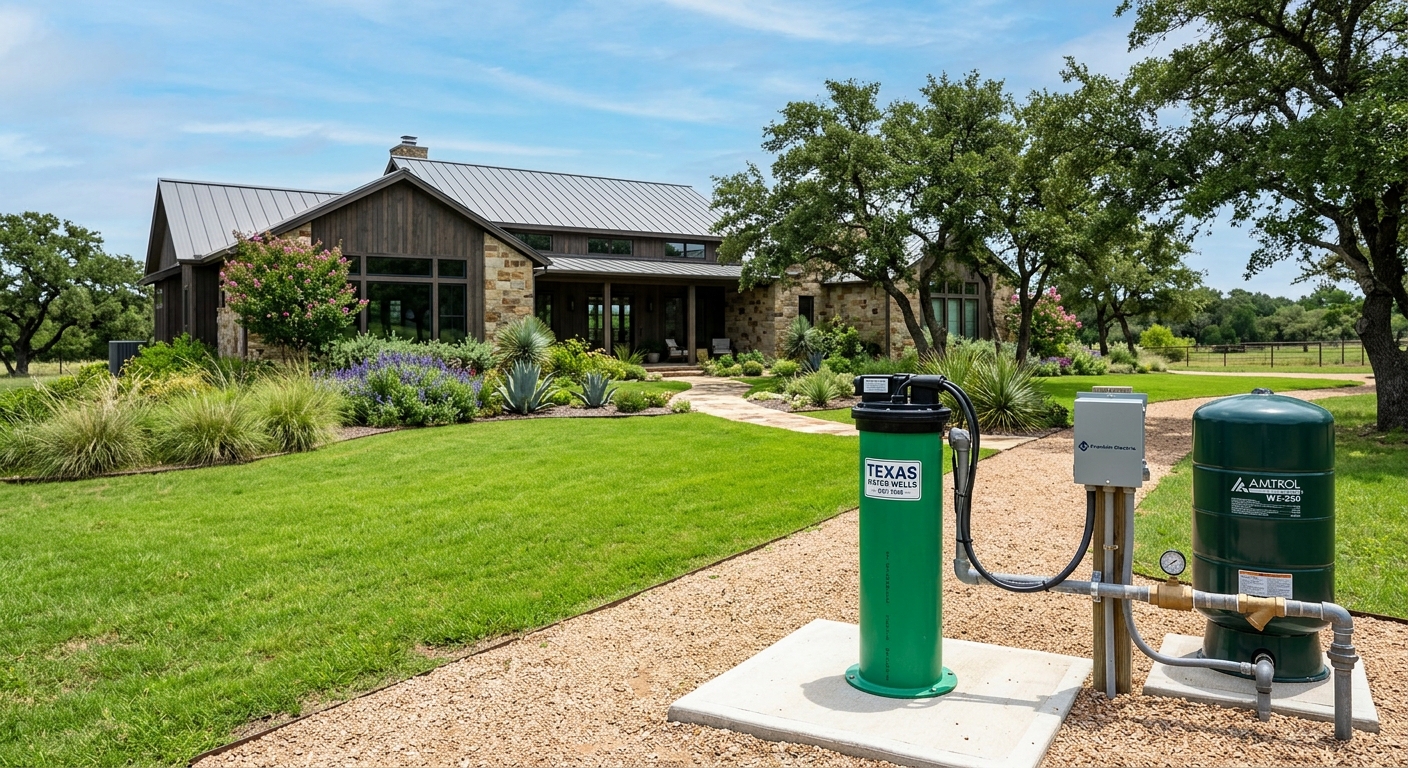
The Trinity Aquifer is one of the most important groundwater systems for private wells in North Texas and Central Texas. If you own rural land, are buying acreage, are planning a home outside city water service, or are comparing well drilling options, the Trinity Aquifer can affect almost every practical decision: how deep the well may need to be, what yield is realistic, what water treatment may be needed, and which groundwater district rules apply before drilling.
This guide is written for property owners, buyers, land agents, builders, and real estate professionals who need a plain-English working understanding of the Trinity Aquifer. It is not a substitute for a licensed driller, groundwater professional, or local Groundwater Conservation District. It is a planning guide for the questions that should be answered before money, time, and expectations get committed to a well project.
The Trinity is not a simple underground lake. It is a layered aquifer system made of sands, sandstones, gravels, limestone, shale, clay, and confining units that change across Texas. Two properties in the same county can have different well depths because the water-bearing layers dip, thin, thicken, pinch out, or become separated by tighter rock. County averages can help with orientation, but nearby well records and local geology are more useful.
TurnkeyWells exists because property-level water well decisions should be made with data, not guesswork. A driller’s experience matters, but so does the record of wells already drilled nearby. Before drilling, a property owner should know whether existing wells are on record near the property, how deep those wells went, what yields were reported, which aquifer was listed, whether the property is inside a groundwater district, and what filings or spacing rules might apply.
Quick Facts About the Trinity Aquifer
| Planning Item | Practical Property Owner Meaning |
|---|---|
| Aquifer type | Layered sandstone and carbonate aquifer system, not a single underground river |
| Main Texas region | North Texas, the western and northern side of the DFW area, parts of Central Texas, and the Hill Country edge |
| Common well use | Domestic wells, ranch wells, small public supply wells, irrigation in some areas, and municipal supply in selected locations |
| Typical domestic well depths | Often a few hundred feet, but can be much deeper downdip or in eastern portions of the system |
| Common domestic yield range | Often modest to moderate, with major variation by county, formation, and local well construction |
| Main planning variables | Target layer, depth, casing, nearby well records, water level, pump setting, water quality, and GCD rules |
| Common water issues | Hardness, iron, manganese, elevated total dissolved solids in some zones, and localized naturally occurring constituents |
| Regulatory check | Many properties require a local Groundwater Conservation District check before drilling |
The Trinity Aquifer is especially important around Parker, Tarrant, Wise, Denton, Collin, Hood, Johnson, Somervell, Bosque, Erath, Cooke, Montague, Grayson, Palo Pinto, and other counties where private wells remain part of rural land ownership. It is also relevant farther south through the Central Texas and Hill Country corridor, where Trinity wells support homes, ranches, subdivisions, and local water systems.
The same aquifer name does not mean the same well result everywhere. A Trinity well in western Parker County is not the same planning problem as a Trinity well in eastern Collin County. A shallow Upper Trinity well is not the same risk profile as a deeper Lower Trinity well.
That is why the right first question is not simply, “How deep is the Trinity Aquifer?” The better question is, “What do nearby well records show for this property?”
Where the Trinity Aquifer Runs in Texas
The Trinity Aquifer extends across a broad band of Texas, beginning near the Red River and continuing south and southwest through North Texas, Central Texas, and into portions of the Hill Country. In practical terms, it matters heavily for the western half of the Dallas-Fort Worth region, rural counties around the Metroplex, and many acreage properties west and south of the urban core.
In North Texas, the Trinity system is tied closely to counties such as Wise, Parker, Tarrant, Denton, Hood, Johnson, Somervell, Bosque, Erath, Cooke, Montague, Palo Pinto, Grayson, and Collin. In Central Texas, the system continues into areas where the Trinity becomes a major water source for rural homes, small communities, and Hill Country properties. The aquifer also interacts with local geology in ways that make county-by-county and property-by-property review important.
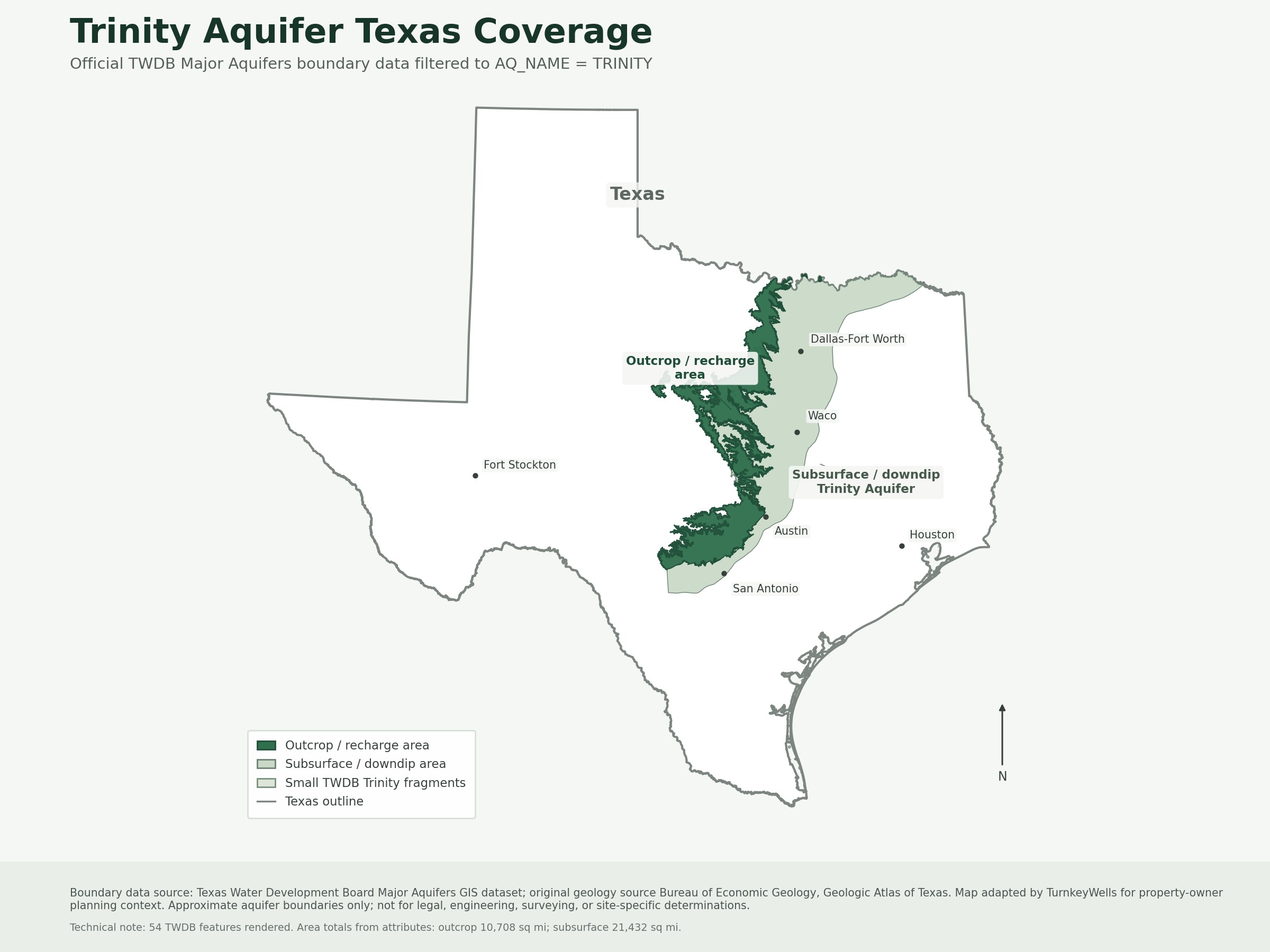
The map matters because the aquifer has two broad practical zones: the outcrop area and the downdip area.
The outcrop is where aquifer formations are exposed at or near the surface. Rainfall has a more direct path into the aquifer there, so the outcrop is an important recharge area. Wells in or near the outcrop can sometimes be shallower, but they may also be more connected to surface conditions. That can affect drought sensitivity, water quality, and seasonal water level behavior.
The downdip area is where the same formations dip deeper underground and are covered by younger geologic layers. Wells in downdip areas often need to be deeper to reach productive water-bearing sands. In some locations, deeper confined water can be more protected from surface influence, but it can also have higher mineral content. A deeper well is not automatically a better well. It depends on the target layer, local records, and construction.
For property owners, the outcrop versus downdip distinction matters for four reasons:
- Depth can change quickly across the aquifer.
- Nearby wells may target different layers even when they are close together.
- Water quality can shift with depth and location.
- Groundwater district rules may treat exempt domestic wells, irrigation wells, and higher-capacity wells differently.
If you are buying land or planning a well, the map is a starting point. It tells you whether the Trinity Aquifer is likely part of the conversation. It does not tell you the exact target depth for your property. That comes from nearby well records, local geology, and site-specific review.
What the Trinity Aquifer Is, and Why the Layers Matter
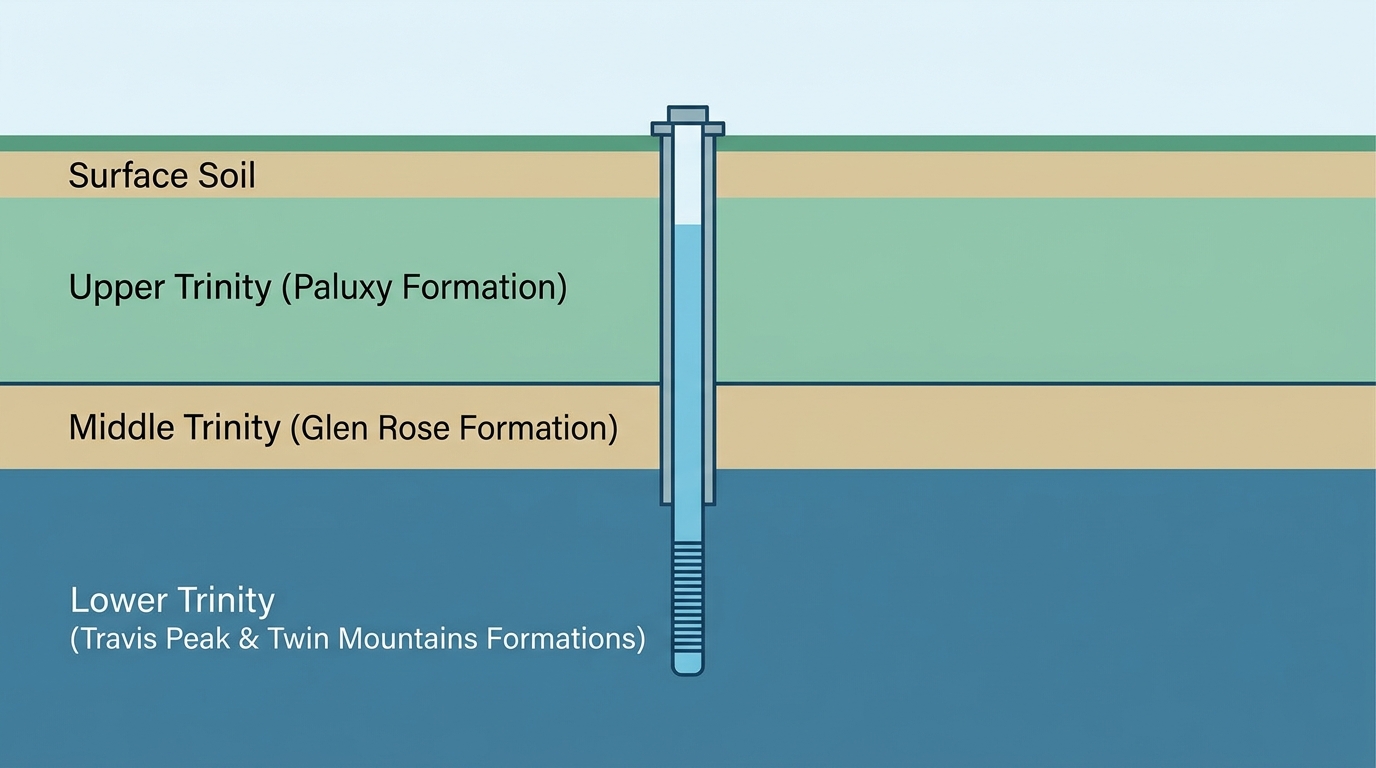
The Trinity Aquifer is a group of water-bearing geologic formations, not a single uniform water body. The system includes the Upper Trinity, Middle Trinity, and Lower Trinity. These names are useful because they help property owners understand why wells can vary so much in depth, yield, and reliability.
In simple terms, water moves through the more permeable sands, sandstones, gravels, and fractured zones. Tighter rock, clay, shale, and some limestone intervals can slow or restrict movement. This creates a layered system where one zone may produce usable water and another nearby interval may act more like a barrier.
Upper Trinity
The Upper Trinity is the shallower part of the system in many areas. It is commonly associated with the Paluxy Formation in North Texas, though local naming and grouping can vary. For property owners, the Upper Trinity can be attractive because it may be reached at shallower depths in some counties. A shallower well can mean a simpler project, less casing, and a shorter drilling interval.
But shallower is not always better. Upper Trinity zones can be more connected to recharge conditions and may respond more directly to drought, local pumping, or surface influence. In some areas, the Upper Trinity can provide enough water for a domestic well. In other areas, it may be less reliable or may not produce the desired yield.
What this means for your well: if nearby records show shallow Upper Trinity wells with steady domestic yields, the upper zone may be a reasonable target. If nearby shallow wells show low yield, dry holes, or inconsistent water levels, the property may need a deeper target.
Middle Trinity
The Middle Trinity includes the Glen Rose interval in many North Texas discussions. This part of the system often includes limestone, shale, marl, and other materials that do not behave like open, highly productive sand. It can contain water, and there are places where it matters locally, but it often acts as a confining or separating unit between upper and lower water-bearing zones.
For a property owner, the Middle Trinity matters because it can separate a shallow water zone from a deeper one. It can affect drilling time, casing choices, and the ability to isolate poorer quality water from better quality water. The Middle Trinity is also part of why a well log can be more useful than a simple depth number. The log shows what the driller encountered, not just how far the hole went.
What this means for your well: the middle layer may not be the main target, but it can strongly affect construction. Proper casing and cementing matter because the well should not allow unwanted mixing between layers.
Lower Trinity
The Lower Trinity is often the deeper and more dependable target in many areas. It includes formations commonly discussed as the Travis Peak, Twin Mountains, or related lower units, depending on location and geologic interpretation. In some northern and western areas, equivalent formations may be grouped differently, such as the Antlers Formation.
Lower Trinity wells can provide stronger and more stable production where the water-bearing sands are present and properly completed. The tradeoff is that they often require deeper drilling. Deeper drilling also increases the importance of casing, pump selection, water chemistry, and long-term maintenance planning.
What this means for your well: a deeper Lower Trinity target may be the right decision when shallow wells nearby are weak or unreliable, but it should be chosen based on actual local evidence. The best starting point is not a generalized county statement. It is the depth, yield, static water level, aquifer name, and completion details from wells close to the property.
A Short History of Trinity Aquifer Use in Texas
The Trinity Aquifer has supported Texas settlement and land use for far longer than modern well databases have existed. Springs, seeps, shallow hand-dug wells, and creek systems tied to groundwater helped shape early travel routes, ranching patterns, and homestead locations. Early property owners did not think in terms of aquifer maps and groundwater management areas, but they understood the practical reality: reliable water determined where people could live and work.
As drilling technology improved, access changed. Windmills, cable-tool rigs, and later rotary drilling made it possible to reach deeper water-bearing zones. Ranches and farms that previously depended on surface water, springs, or shallow wells could use groundwater more consistently. That helped support livestock, small towns, agriculture, and rural homes across large parts of North and Central Texas.
The modern challenge came with growth. As cities expanded, rural subdivisions developed, and municipal and industrial demand increased, groundwater pumping placed more stress on aquifer systems. The drought of the 1950s remains an important reference point because it exposed how vulnerable communities could be when surface water and groundwater were both under pressure.
Over time, Texas shifted toward more formal groundwater management. Groundwater Conservation Districts became the local tool for managing production, spacing, registration, permits, and long-term aquifer goals. Groundwater Management Areas, including GMA planning groups, coordinate desired future conditions across multiple districts and aquifers. The result is a system where the old idea of “just drill a well” no longer fits many properties.
For today’s landowner, the history matters because it explains why the Trinity Aquifer is both valuable and regulated. It has supported generations of property use, but it is not unlimited. A well project now sits at the intersection of geology, property records, construction standards, district rules, and water quality.
Practical Well Depth and Yield Planning
Well depth is the question most people ask first, but yield is the question that determines whether the well works for the intended use. A domestic home may need a different planning standard than a ranch with livestock, irrigation demand, or a property intended for future subdivision.
Depth and yield planning should start with nearby well records. A strong record review looks for several things:
- Wells close to the property, not just in the same county.
- Total depth and screened or completed interval when available.
- Reported aquifer or formation.
- Static water level.
- Reported yield or test rate.
- Drilling date, because old records may not reflect current water levels.
- Plugged or abandoned wells near the property.
- Large-capacity wells nearby that could affect local drawdown.
County-level tables are useful for orientation, but they should be treated as planning guidance. They are not a guarantee or final design. A property near an outcrop, a fault, a local sand body, or a boundary between aquifer units may behave differently from a property only a few miles away.
Representative North Texas Trinity Planning Ranges
| County | Common Trinity Planning Pattern | Practical Well Planning Note |
|---|---|---|
| Parker County | Often moderate depth, with shallow and deeper Trinity targets both possible | Nearby records are important because western and eastern portions can differ |
| Tarrant County | Depths can increase as formations dip and urban development complicates records | Existing well and plugging records are especially useful before buying |
| Wise County | Trinity wells are common and may show favorable rural well patterns | Mineral content and local production history should be checked |
| Denton County | Growth areas can have mixed formation targets and variable depths | A property-level review helps separate good nearby evidence from broad county averages |
| Collin County | Wells may need deeper planning in many rural eastern and northern areas | Do not assume western DFW depth patterns apply |
| Hood County | Shallow to moderate wells are common in many areas, with local drought sensitivity possible | Check recent wells, not only older records |
| Johnson County | Mixed rural and growth corridor conditions | Existing wells, GCD status, and intended use should be reviewed together |
| Somervell County | Trinity and Glen Rose geology are central to the local well conversation | Construction details matter where limestone and confining layers are present |
| Bosque County | Trinity wells can be lower-yield in some local settings | Site selection and realistic yield expectations matter |
| Erath County | Rural and agricultural use makes well history valuable | Nearby yields may vary by local formation and topographic setting |
Several of these counties have published TurnkeyWells location pages with more local well planning context. Verified local county links include Parker County water well drilling planning, Wise County water well drilling planning, Denton County water well drilling planning, Tarrant County water well drilling planning, Somervell County water well drilling planning, Hood County water well drilling planning, Bosque County water well drilling planning, and Erath County water well drilling planning.
Why Parker County and Collin County Can Be So Different
Parker County and Collin County are both part of the broader North Texas well planning conversation, but they are not the same drilling problem. Parker County sits closer to areas where Trinity units are commonly part of rural well development and where shallower or moderate-depth wells may be present. Collin County, especially in rural growth areas away from municipal service, can involve deeper planning, different formation targets, and more sensitivity to the exact local record.
This is the point that many property owners miss. A friend in one county may have a successful well at one depth, but that does not transfer cleanly to another county or even another side of the same county. The Trinity layers dip and change. Local sand thickness changes. Static water levels change. Water chemistry changes. District rules can change.
When a buyer asks whether a property is “good for a well,” the useful answer is not yes or no. The useful answer is a short list of evidence: nearby wells, their depths, reported yields, aquifer names, water levels, plugged records, groundwater district status, and whether anything nearby suggests risk.
Trinity Aquifer Water Quality: What Property Owners Should Expect
Trinity Aquifer water is often usable and valuable, but it should not be assumed to be treatment-free. Water quality varies by depth, formation, local recharge, residence time, and well construction. A well that produces enough water can still create practical problems if the chemistry is not understood.
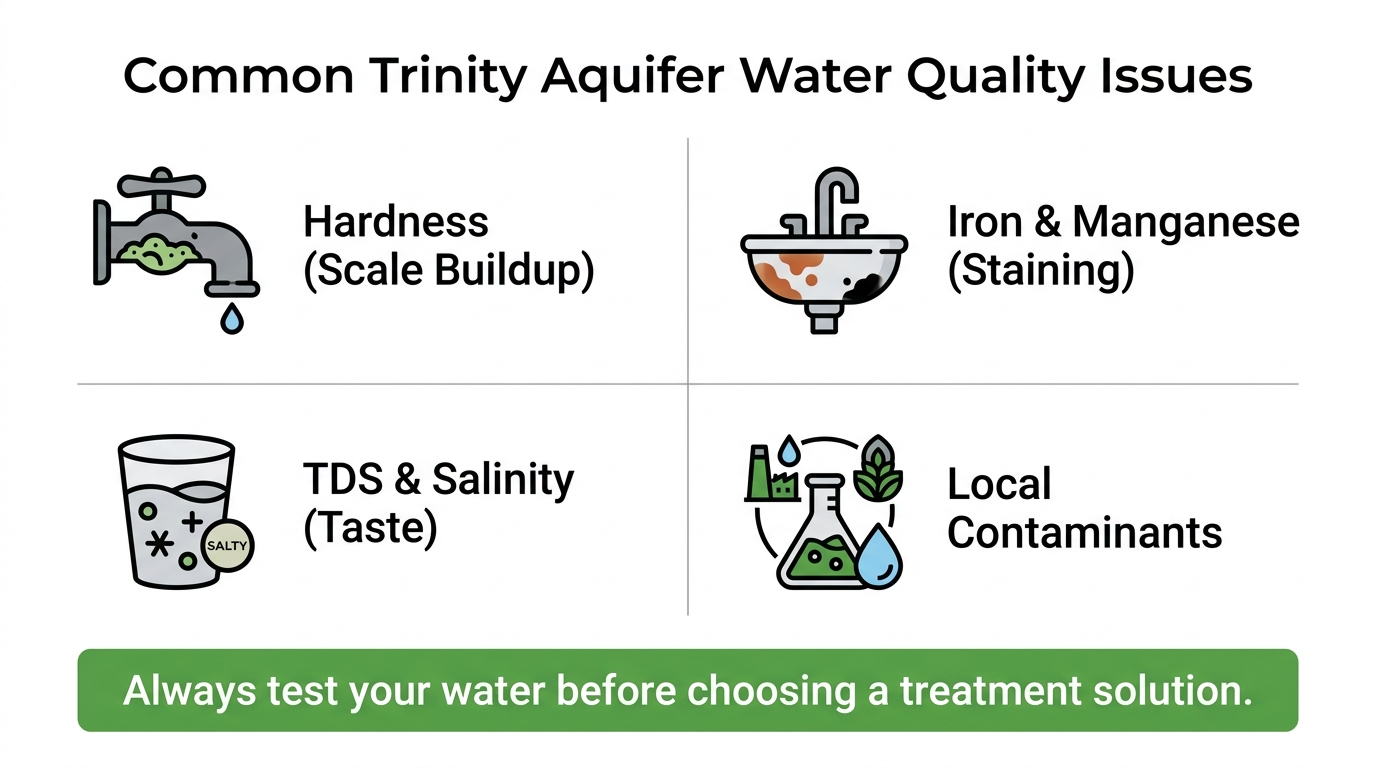
The common owner-facing issues are hardness, iron, manganese, total dissolved solids, and localized naturally occurring constituents. These are not all the same kind of problem. Some mainly affect fixtures and appliances. Some affect taste and staining. Some require more careful testing before treatment decisions are made.
Hardness
Hard water is common in many Texas groundwater systems. In a home, hardness often shows up as scale on fixtures, spots on glass, soap that does not lather well, and mineral buildup in appliances. Hardness is usually caused by calcium and magnesium. It is often managed with a water softener, but the right treatment should be based on actual test results.
The property owner takeaway: hardness is common and manageable, but it should be measured.
Iron and Manganese
Iron and manganese can create red, brown, orange, gray, or black staining. They can affect taste and can make water look worse than it actually is. In some wells, iron appears dissolved and looks clear at first, then stains after exposure to air. In other cases, particles may be visible.
Treatment can involve oxidation, filtration, softening support, or more specialized systems depending on the form and concentration.
The property owner takeaway: staining is a clue, not a diagnosis. Test first, then match treatment to the chemistry.
Total Dissolved Solids and Salinity
Total dissolved solids, often called TDS, refers to dissolved minerals in water. In some Trinity zones, especially deeper or downdip settings, TDS can increase. Higher TDS can affect taste, fixture residue, and treatment planning. In more mineralized water, point-of-use reverse osmosis may be used for drinking water, but whole-house treatment decisions need careful review.
The property owner takeaway: deeper water can be more reliable in some settings, but deeper water is not automatically better tasting. Depth and water quality should be considered together.
Localized Constituents
Some areas may have naturally occurring constituents that require a broader lab panel. Depending on location, this can include items such as fluoride, arsenic, radionuclides, sulfate, chloride, nitrate, or other parameters. Not every Trinity well has these issues, but a new well or property purchase should not rely on a narrow test if the water will be used for a home.
The property owner takeaway: a certified lab test is part of responsible well ownership. Taste, smell, and color are useful observations, but they are not enough.
Groundwater Conservation Districts, GMA Planning, and Permitting
A Trinity Aquifer property may or may not be inside a Groundwater Conservation District, usually called a GCD. If it is inside a GCD, drilling and operation may be subject to local rules. Those rules vary by district. Some domestic and livestock wells may be exempt from full permitting but still require registration, spacing compliance, drilling notices, or completion filings. Larger or non-exempt uses may face more detailed permitting and reporting.
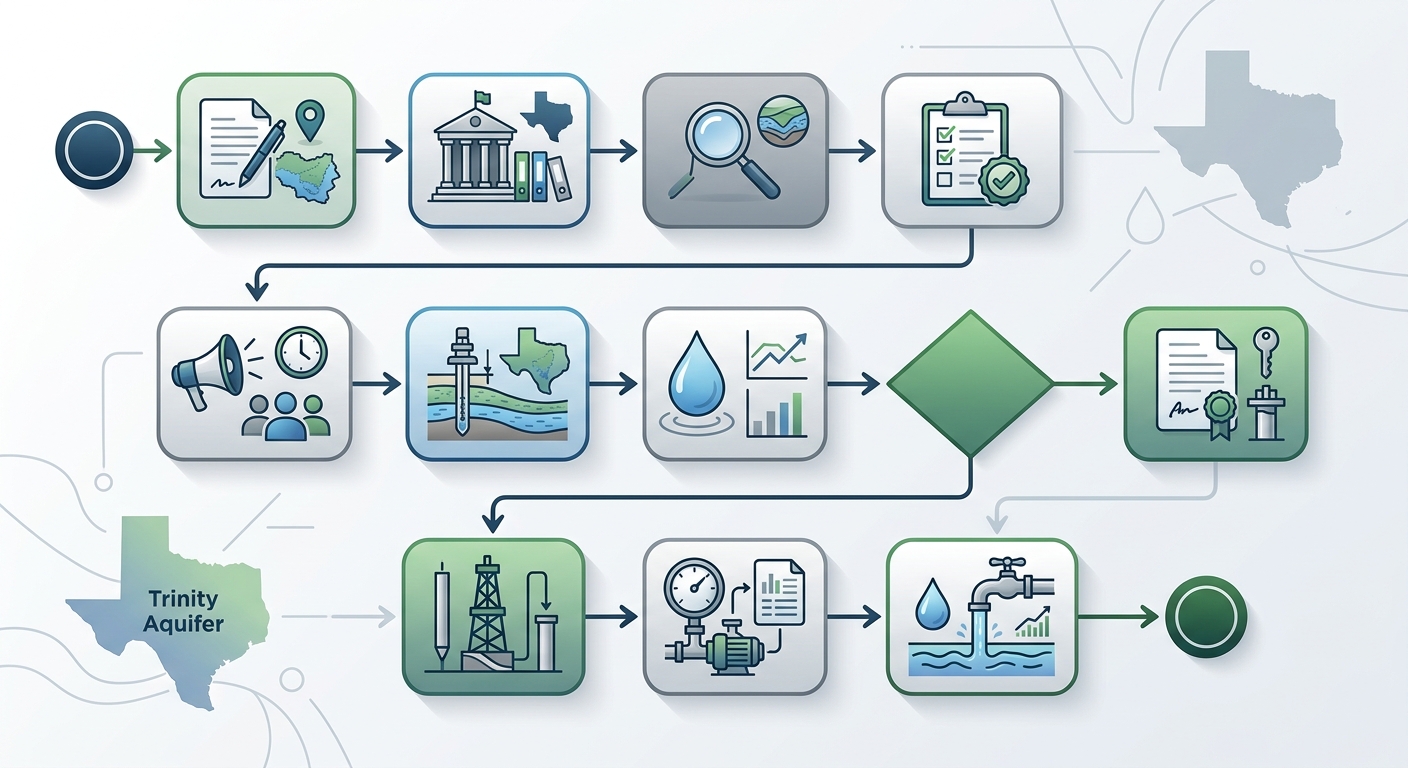
Groundwater Management Areas, including GMA 8 across much of North Texas, coordinate planning across multiple groundwater districts. They do not replace local district rules for a property owner, but they shape long-term aquifer management through desired future conditions and planning goals. For a landowner, the local GCD is usually the practical point of contact.
Before drilling a Trinity Aquifer well, check these items:
- Is the property inside a Groundwater Conservation District?
- Is the planned well exempt or non-exempt under local rules?
- Are there spacing rules from property lines, septic systems, existing wells, or other features?
- Is a drilling permit, registration, or notice required before work starts?
- What completion paperwork is required after drilling?
- Are there production limits, meter rules, or annual reporting requirements?
- Are there local drought rules or temporary restrictions?
- Does the district require a licensed driller to file specific records?
TurnkeyWells built a free Texas Groundwater Conservation District Lookup Tool because this question should be answered early. GCD status can affect schedule, paperwork, and whether a property owner’s intended use fits local rules. The lookup is not a substitute for district confirmation, but it is a practical first step before calling drillers or writing contract assumptions into a land deal.
For buyers, GCD status can also matter during due diligence. If a property already has a well, the buyer should ask whether the well is registered, whether the owner has records, whether the well is active or plugged, and whether any district paperwork is missing. If a property does not have a well, the buyer should know whether local rules could affect the timeline before drilling.
What to Check Before Drilling a Trinity Aquifer Well
A good pre-drill review is not complicated, but it needs to be specific. The goal is to reduce avoidable surprises before the project starts. The owner should not expect perfect certainty. Groundwater always has some uncertainty. But the owner should expect a better answer than “wells around here are usually fine.”
Start with the property itself. Confirm the address, parcel, county, and intended use. A domestic well for one home is a different planning case than a subdivision, commercial site, irrigation project, or high-volume livestock operation. The intended use influences target yield, pump sizing, district rules, and long-term maintenance.
Next, review nearby well records. Public records can show wells that were drilled near the property, their reported depths, yields, water levels, completion dates, and sometimes aquifer names. The most useful records are close to the property and geologically relevant. A well ten miles away may not tell you much if the formation changes between the two sites.
Then review plugged and abandoned wells. Old wells can matter for safety, contamination risk, title concerns, and future construction. Plugging records can also help show past groundwater use in the area.
Check the groundwater district. Do this before assuming a drilling timeline. Some districts have straightforward domestic well processes. Others may require more coordination. The question is not whether Texas “allows wells.” The question is what applies to this property, this aquifer, this use, and this district.
Review septic and setback issues. Private wells and septic systems are often part of the same rural property plan. The well location should be considered alongside septic design, property lines, buildings, driveways, livestock areas, flood-prone areas, and future improvements.
Ask about water quality expectations. A driller may know common local issues, but lab testing should drive treatment decisions. If nearby wells show high mineral content or staining issues, plan for testing and treatment rather than being surprised after the well is complete.
Finally, understand that drilling is not the entire water plan. The property owner still needs to think about pump equipment, pressure tank, storage if needed, treatment, electrical service, maintenance access, district paperwork, and future testing.
How TurnkeyWells Fits Into the Trinity Aquifer Decision
TurnkeyWells is not trying to replace the driller. A good licensed driller is essential. The TurnkeyWells role is to help property owners and real estate professionals understand the record before the drilling decision, property purchase, or listing conversation gets too far down the road.
The first step for many owners is the Free Well Check. It is designed to help you look up what is already on record around a property. If there are registered wells nearby, that information can frame the next questions: how deep did they go, what yield was reported, how old are the records, and does the surrounding pattern support the owner’s expectations?
The Free Well Check is especially useful when a property already has a well, when a buyer is unsure whether a well is on record, or when a seller wants to understand what public data may show.
For drilling decisions, the Pre-Drill Intelligence Report is the better fit. A pre-drill review should connect the address to nearby well records, aquifer context, depth and yield expectations, driller history where available, groundwater district status, and red flags that may affect the project. The goal is not to promise the exact well result. The goal is to improve the quality of the decision before drilling begins.
For regulatory screening, use the GCD Lookup Tool early. GCD status is one of those items that can seem minor until it changes the paperwork path. If the property is inside a district, confirm the rules directly with that district before drilling.
Trinity Aquifer Counties and Local Planning Pages
The Trinity Aquifer is relevant across many Texas counties, but TurnkeyWells only links to county pages that are verified in the local published-page manifests. Current verified internal county pages that are relevant to the Trinity planning conversation include:
- Parker County water well drilling and Trinity Aquifer planning
- Wise County water well drilling and rural well planning
- Denton County water well drilling and formation planning
- Tarrant County water well drilling and existing record review
- Collin County water well drilling and deeper well planning
- Grayson County water well drilling and Trinity Aquifer context
- Johnson County water well drilling and private well planning
- Hood County water well drilling and local aquifer review
- Somervell County water well drilling and Glen Rose geology context
- Bosque County water well drilling and rural yield planning
- Erath County water well drilling and agricultural well planning
- Palo Pinto County water well drilling and Trinity Aquifer planning
- Cooke County water well drilling and North Texas well planning
- Montague County water well drilling and rural groundwater planning
County pages are helpful because groundwater decisions are local. The Trinity Aquifer may be the broad system, but the property owner needs the county, district, and nearby record context. A buyer in Somervell County may need to understand Glen Rose and Trinity conditions. A buyer in Denton County may need to understand growth-area well patterns. A landowner in Wise County may care more about rural production history and water quality. A seller in Tarrant County may need to know whether older well records could show up in public data.
Common Mistakes Property Owners Make With Trinity Wells
The first mistake is relying on a neighbor’s well as if it guarantees the same result. Neighboring wells are useful evidence, but they are not a promise. The formation may change, the completed interval may differ, the pump may be set differently, and the reported yield may come from a different test method or season.
The second mistake is treating depth as the only question. A deeper well can still have water quality concerns. A shallower well can still be adequate. A well that produces enough water during drilling may need proper pump selection and long-term monitoring. Depth is important, but it is only one part of the plan.
The third mistake is waiting too long to check groundwater district status. GCD rules can affect spacing, permits, registration, production limits, and paperwork. If the district check happens after a closing deadline or construction schedule is already tight, it can create avoidable stress.
The fourth mistake is skipping water testing or buying treatment based on a quick sales recommendation. Trinity water quality can be manageable, but treatment should match the actual lab result. A softener, iron filter, sediment filter, reverse osmosis unit, or other system should be selected because the chemistry calls for it.
The fifth mistake is ignoring old wells. Existing, abandoned, or improperly plugged wells can matter for safety, property value, compliance, and contamination risk. A rural property can have a well history even when the current owner does not have documents handy.
A Practical Trinity Aquifer Checklist
Use this checklist before drilling, buying, selling, or planning improvements on a property that may rely on the Trinity Aquifer:
- Confirm the property address, parcel, county, and intended water use.
- Run a property-level well record review.
- Check nearby well depths, yields, water levels, aquifer names, and dates.
- Look for plugged, abandoned, or old wells near the property.
- Identify whether the property is inside a Groundwater Conservation District.
- Confirm whether the planned well is exempt or non-exempt under local rules.
- Review spacing requirements for property lines, septic systems, and existing wells.
- Ask whether the likely target is Upper Trinity, Lower Trinity, or another local formation.
- Discuss casing and construction expectations with a licensed driller.
- Plan for certified water testing after the well is completed or before relying on an existing well.
- Match water treatment to lab results.
- Keep well records, district paperwork, test results, pump information, and maintenance notes in one property file.
This checklist is simple, but it is the difference between hoping the well works and making a documented decision. The Trinity Aquifer is too variable for guesswork to be the plan.
Bottom Line
The Trinity Aquifer is one of the core groundwater systems behind private well ownership in North Texas and Central Texas. It supports homes, ranches, farms, small communities, and land development, but it does not behave the same way everywhere. The layers matter. The county matters. The nearby records matter. The groundwater district matters. Water quality matters.
For a property owner, the best approach is practical: identify the aquifer context, review wells near the property, understand likely depth and yield, check GCD status, plan for water testing, and talk to a licensed driller with better information in hand.
Before you drill, buy, sell, or make assumptions about a Trinity Aquifer property, start with the record. Use the Free Well Check to see what is already on file around the address. If the project is moving toward drilling, use the Pre-Drill Intelligence Report to turn nearby well data, aquifer context, and local rules into a clearer plan. If the regulatory question is the immediate concern, start with the Texas GCD Lookup Tool and confirm details with the local district.
Start With the Property Record
Before you drill, buy, sell, or make assumptions about a Trinity Aquifer property, check what is already on file around the address.
For a shallow river-corridor groundwater comparison, review the Brazos River Alluvium Aquifer Texas property guide.