Orange County, Texas
Water well drilling in Orange County
TurnKey Wells helps Orange County property owners move from county well records to property-specific questions and a clear drilling estimate. Tell us where the property is and what the well needs to support.
- Address-based project intake
- Property-specific planning
- Clear next steps
Screening land in Orange County? Start with public records, then tie the comparison to the exact property.
What 1,536 positive-depth household records tell you
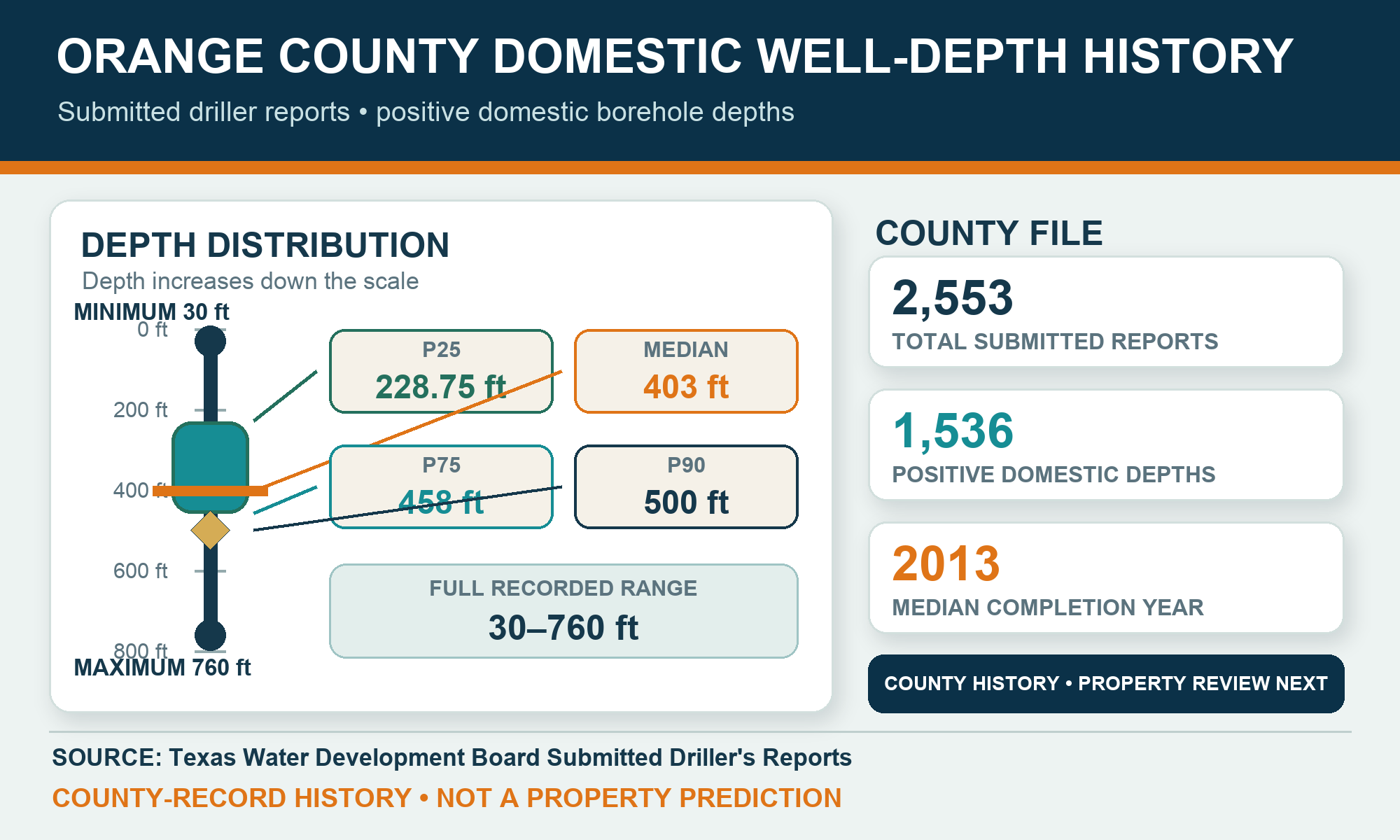
Orange County has 1,536 domestic reports, and each includes a positive borehole depth. Those logs have a 403-foot median, while their middle half runs from 228.75 to 458 feet. The 90th-percentile planning marker is 500 feet, and the full recorded range is 30 to 760 feet.
That spread is a reason to avoid treating one county figure as a property estimate. Nearby comparable records, intended demand, access, construction choices, source documents, flood exposure, drainage, and site conditions all belong in the review.
Recorded domestic borehole depths
The middle half of positive reported domestic borehole depths
Orange County’s well file serves several purposes
Domestic use accounts for 1,536 of the county’s 2,553 submitted reports. Monitoring and environmental soil-boring work account for another 552 and 173 records. Irrigation, rig-supply, test, industrial, public-supply, stock, other, de-watering, and injection filings make up the rest, so each record should stay attached to its reported purpose instead of being blended into a household planning comparison.
Domestic records
All 1,536 domestic filings include a positive depth. Their 403-foot median sits inside a 228.75-to-458-foot middle band.
Monitor records
All 552 monitoring filings include a positive depth, with a 20-foot median and a separate observation purpose.
Environmental soil borings
All 173 filings include a positive depth. Their 11-foot median belongs to site investigation, not household supply.
Irrigation records
All 103 filings include a positive depth, with a 90-foot median and a different demand pattern.
Rig-supply records
All 91 filings include a positive depth; their 130-foot median is not a household-well benchmark.
The file also contains 56 test-well records, 17 industrial records, 10 public-supply records, seven stock records, five other records, two de-watering records, and one injection record.
Orange County records need to be sorted by purpose
A countywide average that blends household wells with monitoring, environmental, irrigation, rig-supply, test, industrial, public-supply, stock, de-watering, and injection work is not a clean comparison. Household planning should begin with domestic records while keeping each filing’s reported purpose in view.
The complete Orange County job is more than drilling footage
Gate width, road conditions, overhead lines, septic placement, distance to power, intended demand, and equipment choices all belong in the plan.
Property access
Roads, gates, low branches, overhead lines, utility conflicts, turning room, drainage, and a safe stabilized work pad.
Water demand
Household use, livestock, irrigation, storage, treatment, and peak daily needs.
Pump and power
Pump selection, anticipated drawdown, electrical service, controls, pressure equipment, line runs, and trenching.
Complete installation
Casing, completion materials, testing, storage, plumbing, treatment, cleanup, and startup.
Build the estimate around what the Orange County property actually needs.
Share the address, intended use, access, timing, and any existing well information. TurnKey Wells reviews the project context and connects the owner with a qualified water-well professional for the next step.
Separate drilling footage from the finished system
A complete Orange County budget may include mobilization, drilling, casing, completion materials, pump and controls, pressure equipment, trenching, electrical work, storage, testing, treatment, drainage, and cleanup. The Texas water well drilling cost guide explains the major categories behind a headline estimate.
The Pre-Drill Report can bring nearby well records and property details into one review, but no county pattern predicts the producing interval, total depth, water level, yield, salinity, or water quality at one property. Use property-specific research before treating a county pattern as a drilling plan.
- Mobilization and setup
- Drilling and casing
- Pump and controls
- Pressure equipment
- Power and trenching
- Storage and treatment
- Water testing
- Site cleanup
Pre-Drill Intelligence Report
The county information on this page shows broad patterns. The paid report narrows the research to one Orange County property before you compare drilling quotes or choose the next step for your land.
- Nearby recorded wells and reported depths
- Property access and site-planning questions
- Questions to ask before drilling begins
- A clearer picture of the complete water system
Understand the ground before you drill. Property conditions can change across the county. A property-specific review brings nearby well records, location, intended use, access, and complete-system questions together before you request a drilling quote.
From property address to drilling conversation
Tell us about the property
Share the address, how the water will be used, and when you hope to begin.
We review the project
We look at the location and follow up for any details needed to discuss the estimate.
Plan the drilling work
You receive a clear next step for the drilling quote and complete water system.
Plain answers before you plan the work
What do Orange County household well records show?
The county file includes 1,536 positive domestic borehole-depth logs with a 403-foot median and a 228.75-to-458-foot middle band. A property-level comparison is still needed before planning a new well.
Why should Orange County records be separated by use?
Domestic filings are the largest group, alongside monitoring, environmental, irrigation, rig-supply, test, industrial, public-supply, stock, de-watering, and injection uses. Keeping each purpose separate produces a cleaner household planning picture.
Does a countywide depth pattern predict one property?
No. County records do not prove the producing interval, total depth, water level, yield, salinity, or water quality at one property.
Which groundwater rules apply in Orange County?
Registration, permitting, spacing, construction, and reporting requirements can depend on the property, district boundary, well type, and intended use. Confirm current requirements before work begins.
What should a complete drilling quote include?
Compare mobilization, drilling, casing, completion materials, pump and controls, pressure equipment, electrical and trenching work, testing, treatment or storage where needed, startup, and cleanup.
Water well planning across Orange County
Property owners ask about well planning around Orange, Vidor, Bridge City, Mauriceville, Orangefield, West Orange, Pinehurst, Little Cypress, and rural acreage between them. Start with the exact address or coordinates, intended water use, access, utilities, drainage, and nearby domestic records; a community label does not prove shared geology, water quality, or private-well feasibility.
Tell us about your Orange County property.
Send the basics and we will follow up to learn what you need, answer initial questions, and discuss the next step toward a water well drilling quote.
- No long questionnaire
- A real follow-up about your property
- Clear options for drilling and pre-drill planning
Request a Water Well Drilling Quote
Tell us where the property is and what the well needs to support.
Your information is used to respond to this request. Privacy Policy