Texas Private Well Problems
Well Control Box Problems in Texas
A bad well control box can cause no water, hard starts, humming, breaker trips, or a pump that refuses to run cleanly even though the pressure switch seems to be calling for water. On Texas private wells that use a three-wire submersible pump, the control box is one of the first places a bad diagnosis can waste money if nobody confirms whether the real failure is in the box, the wiring, the pressure controls, or the pump down in the well.
Quick Answer
What it usually means
The control box may have a failed capacitor, relay, wiring connection, or heat-damaged component, but it can also be reacting to a bigger pump or electrical problem.
Most common symptoms
No water, a pump that hums but does not start, repeated breaker trips, a burnt smell, or a system that starts only some of the time.
What to inspect first
Confirm the well even uses a control box, then check breaker behavior, pressure switch response, visible wiring condition, and whether storms or recent service happened right before the failure.
When to stop resetting
If the box smells burnt, the breaker keeps tripping, or the pump will not start cleanly, cut power and get qualified help instead of forcing repeated restarts.
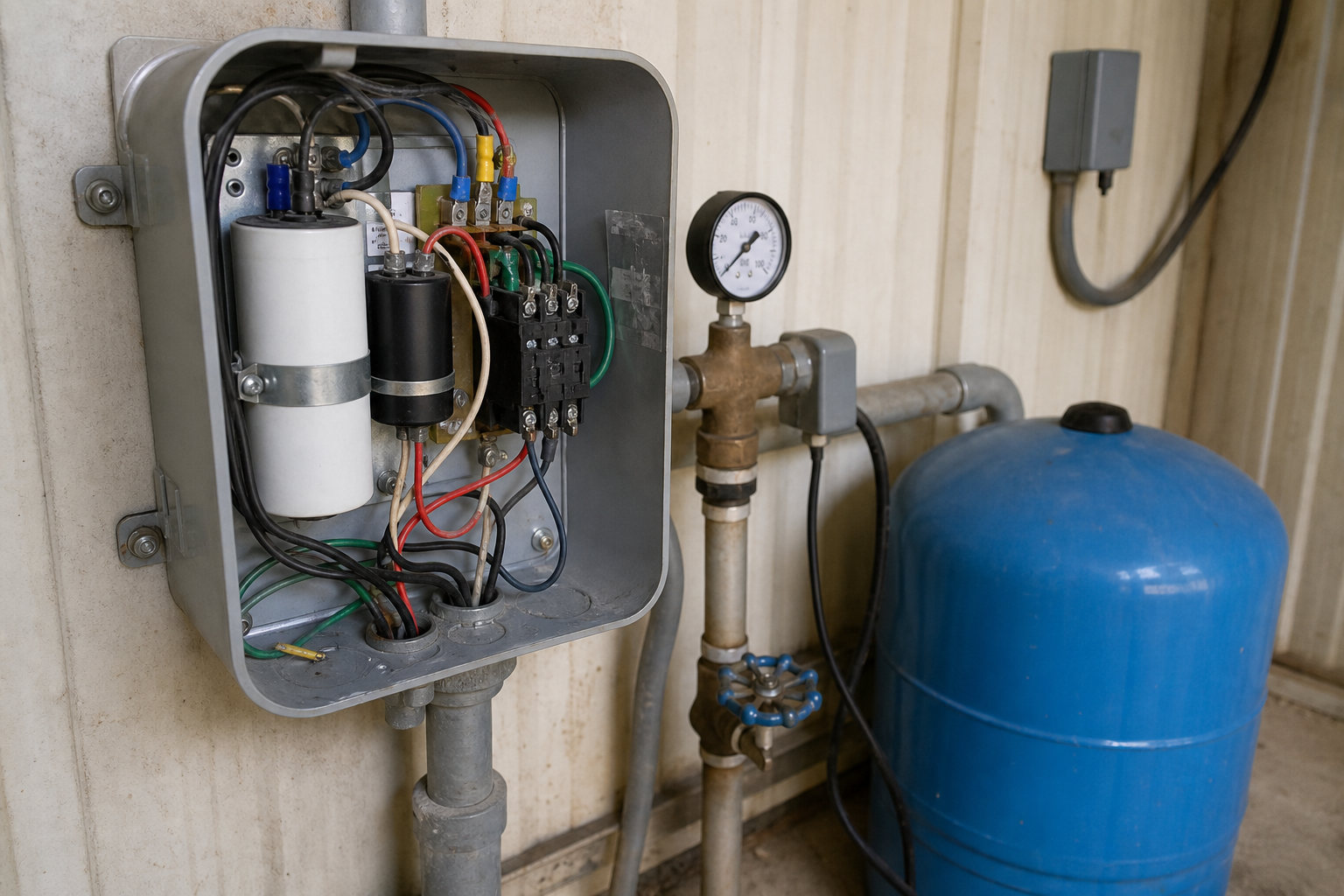
What a Well Control Box Actually Does
Not every private well has a control box. Many two-wire submersible pumps do not. But on three-wire pump systems, the control box helps the motor start and run by managing key electrical components outside the well. When that box fails, the system can act dead, act inconsistent, or create symptoms that look like a bad pressure switch or a dead pump even when the real trouble is sitting on the wall in plain sight.
That is why this problem deserves a little discipline. A failed capacitor can mimic a failed pump. A scorched relay can make a healthy motor look worse than it is. A voltage issue or lightning hit can damage both the box and the pump. If the diagnosis stops at, “the control box looks old,” owners can replace one part and still be left with no water.
Common Signs of Well Control Box Trouble
The pump hums but does not start cleanly. One of the classic signs is a system that tries to start, hums, or struggles, then trips power or stalls out. That often points to a control-box component that is no longer doing its job during start-up.
The breaker trips over and over. Repeated trips can mean shorted wiring, a failing box, or a pump motor pulling the wrong load. The control box may be the failure point, but it may also be the place where a deeper pump problem finally shows itself.
The system works sometimes, then quits. Heat, vibration, moisture, and loose connections can create an intermittent failure that comes and goes. That is the kind of symptom that tricks owners into thinking the problem is “fixed” after one reset.
There is a burnt smell, visible heat damage, or buzzing. Those are not minor clues. If the box smells burnt, has obvious scorching, or makes unusual noise, stop resetting the system and move toward a qualified diagnosis.
Control-box trouble is often a system diagnosis problem, not just a box-swap problem. The right answer may be in the box, but it can also involve the pressure switch, voltage supply, pump motor, wire splice, or a bigger well-performance issue.
What Usually Causes a Well Control Box to Fail
Age and heat. Outdoor enclosures, pump houses, and utility sheds in Texas put constant heat stress on electrical parts. Capacitors, relays, and terminals do not last forever.
Lightning and electrical stress. Storm country matters here. Voltage swings, lightning events, or older rural electrical service can damage the box directly or shorten the life of components that were already weak.
Moisture, insects, and corrosion. Ants, wasps, humidity, and condensation are common on Texas acreage. A control box mounted in a rough environment ages faster than one in a clean conditioned space.
A deeper pump problem. If the motor down in the well is beginning to fail, the control box may show the symptom first. That is why a brand-new box that burns up again or still will not start the pump is a warning sign, not just bad luck.
Texas Conditions That Change the Diagnosis
Texas wells operate through heavy heat, storm seasons, long dry spells, power irregularities, and wildly different water-use patterns from one property to the next. A lightly used country home, a working ranch, and a buyer’s recently acquired acreage can all have the same no-water symptom for different reasons. On a drought-stressed system, low well recovery may already be pushing the pump harder. On a sandy or mineral-heavy system, the pump itself may be living a harder life. On an older property with poor records, no one may know whether the pump is two-wire or three-wire until the lid comes off.
That is where context matters. A TurnkeyWells Free Well Check helps line up the records, surrounding well context, and the right questions before anyone spends money in the wrong place. If the bigger issue is whether the existing well is worth more repair money at all, the Pre-Drill Intelligence Report helps compare nearby well depth and planning conditions before the conversation jumps to a replacement well.
What to Inspect Before Replacing Anything
Start with the basic facts. Does the system actually use a control box. Is the breaker tripping immediately or after a few seconds. Does the pressure switch call for water. Are there loose or heat-darkened wires. Did the failure begin after a thunderstorm, a recent pump pull, or a long vacancy. Is the pressure gauge behaving honestly or stuck. Those clues can narrow the diagnosis faster than guesswork.
It also helps to compare symptoms across related pages. If the system pressure has been erratic, review our guide to well pressure switch problems in Texas. If the house has no water at all, compare it with well pump runs but no water in Texas and submersible well pump problems in Texas. The overlap matters because a control box is only one part of the chain.
What a Well Professional Should Check
A qualified water well professional should confirm the pump type, test voltage and amp draw, inspect the control-box components, verify switch behavior, and determine whether the motor is actually starting and running the way it should. If the box is replaced, the job is not really done until the system proves it can start, build pressure, and shut off normally under real water use.
That field review matters because the wrong repair path is expensive. Replacing the control box on a failing motor wastes money. Pulling the pump before anyone confirms a cooked capacitor can also waste money. The goal is to understand whether the control box is the cause, the victim, or just the clue that finally got noticed.
Buyer and Seller Angle
Control-box trouble matters in a Texas real estate deal because it raises immediate questions about system age, maintenance, storm history, and whether the pump itself may be close behind. Buyers do not want to inherit a “small electrical repair” that turns into a pulled pump two weeks after closing. Sellers need better documentation than “the box was swapped once” if they want to avoid repair credits and closing friction.
This is exactly the kind of issue that belongs in stronger due diligence around the TREC Form 61-0 Texas water disclosure guide. A clean repair with invoices and a stable system is one story. Repeated electrical trouble with thin records, storm damage, or a pump that still starts hard is a different story.
Do Not Let a Small Gray Box Send You Toward the Wrong Invoice
When a control box fails, it is tempting to swap the visible part and hope the system comes back. Sometimes that works. Sometimes it only hides the bigger problem for a week. Texas owners save money when they confirm whether the box is actually the root cause, understand what kind of pump is in the well, and line up the right field diagnosis before the repair path gets expensive.
TurnkeyWells helps property owners review records, narrow the likely cause, and connect them with qualified local help when field work is needed. The smarter path is to understand the whole well story before a control problem turns into a blind spending spree.
Get the Bigger Well Story Before You Approve a Control Box or Pump Repair
TurnkeyWells helps Texas property owners organize records, understand the likely cause of a control failure, and connect them with qualified local help when field work is needed.
Start with a Free Well CheckNeed help with this control-box issue?
Contact TurnkeyWells and we can help review the issue and connect you with licensed local help.
Tell us what the system is doing, where the Texas property is located, and whether this is for a home, land purchase, listing, or active repair situation. TurnkeyWells can help review the issue, organize the next step, and connect you with a licensed water well professional in your area when field work is needed.
TurnkeyWells helps organize records, explain likely next steps, and connect customers with qualified local help. TurnkeyWells is not the drilling or repair contractor.