Texas Private Well Problems
Submersible Well Pump Problems in Texas
Submersible well pump problems can show up as no water, weak pressure, breaker trips, or dirty water after the system restarts. Because the pump sits down in the well, Texas property owners often replace the wrong surface part first and lose time while the real failure keeps getting worse.
Quick Answer
What it usually means
The pump motor, impellers, wire splice, drop pipe, control components, or well recovery may be failing together instead of as one clean single-part problem.
First symptom to notice
The house loses water, pressure fades during use, the breaker trips, or the system gets noisy after sitting idle.
What to inspect first
Check the breaker, pressure gauge, pressure switch behavior, visible leaks, filter restriction, and whether the problem started after storms, drought, or recent service.
When to move faster
If the house has no water, the pump trips power repeatedly, or the water turns dirty after restart, stop guessing and get qualified help.
What a Submersible Pump Problem Looks Like
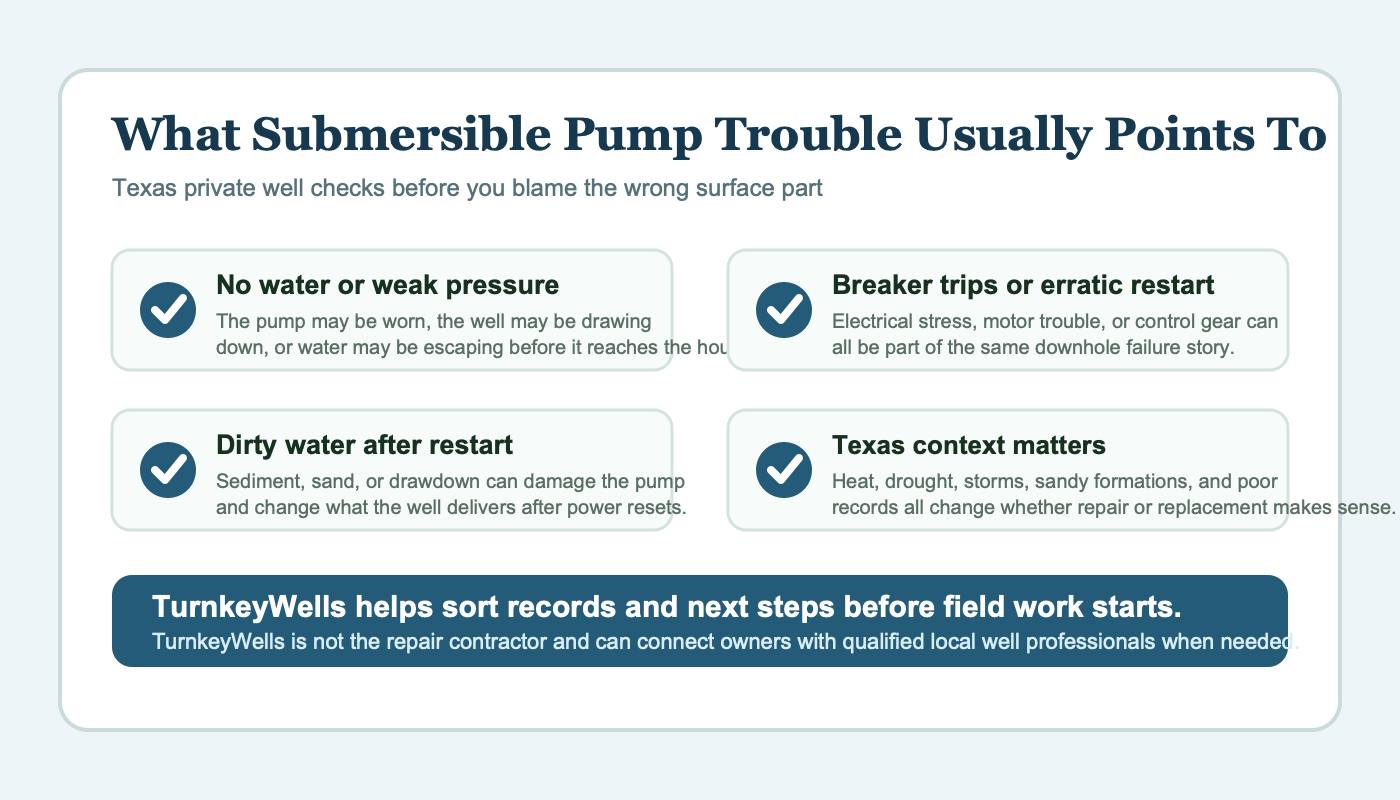
A submersible pump lives down in the well and pushes water up to the house. When that pump starts failing, the symptom at the faucet is usually indirect. Owners notice weak pressure, a sudden no-water event, a breaker that trips, pressure that collapses during long showers, or water that comes back dirty after the system is reset. Because the pump is out of sight, it is easy to blame the pressure tank, the switch, or the filter before anyone confirms what is happening below grade.
That is why submersible pump diagnosis needs a little discipline. A bad pump can look like a bad pressure switch. A low-yield well can look like a bad pump. A cracked drop pipe or failing check valve can make the whole system act unstable even if the motor still runs. If the system behavior feels more like a control issue than a downhole issue, compare the symptoms with our guides to well pressure switch problems in Texas and low water pressure from a private well in Texas.
Common Signs the Submersible Pump May Be the Real Problem
No water after the pump should be running. You hear or sense activity at the system, but the house does not regain flow. That can point to a failed motor, broken coupling, split drop pipe, or a well that is not actually delivering water to the pump intake.
Pressure starts normal, then falls away. This often happens when the well is drawing down, the pump is worn, or sediment has started to damage impellers. It can also happen when a hidden leak in the drop pipe or yard line wastes what the pump is producing.
The breaker trips or the control box acts erratic. Electrical trouble does not automatically prove the pump is dead, but repeated breaker trips, humming, or inconsistent restart behavior can be part of the same failure chain. On three-wire systems, the upcoming control-box check matters too. The pump itself may still be the expensive part at the center of the problem.
Dirty water after restart. Sand, silt, or rust-colored water after the system has been reset can mean the pump is disturbing sediment, the well is drawing down too far, or the system has casing, screen, or wellhead issues that should not be treated as a simple house-plumbing problem.
Submersible pump trouble is often a system problem, not just a pump problem. The right answer may involve the pump, but the diagnosis should also cover the tank, switch, wiring, well recovery, and record history before money gets spent.
What Usually Causes Submersible Pump Failure
Normal motor and impeller wear. Pumps do not last forever. Years of cycling, mineral-heavy water, and abrasive sediment eventually wear motors and impellers down until pressure and flow fall off.
Sand and sediment. In parts of Texas, especially where wells are producing from sandy formations or disturbed after storms and service work, sediment can grind away internal pump parts faster than owners expect.
Low-yield well conditions. A pump that outruns the well can overheat, cycle badly, or pull water levels down to the intake. That is one reason repeated pump replacement without a bigger well-capacity conversation can become a money pit.
Electrical stress. Lightning, voltage irregularities, outdoor wiring exposure, ants in control equipment, and old rural electrical setups can all shorten pump life. The surface symptom may look electrical even when the pump is already failing below.
Age plus poor records. When nobody knows when the pump was installed, how deep it sits, or whether prior failures were repaired correctly, owners start every new symptom with a blindfold on. That is a real Texas acreage problem in older properties and inherited ranch setups.
Texas Conditions That Change the Diagnosis
Texas private wells do not fail in a vacuum. Long hot weather increases water demand. Drought can expose yield limits that were hidden during wetter years. Heavy rain can stir up sediment or reveal drainage and wellhead problems. Gulf Coast and East Texas properties may fight sand and iron. Rock-well areas may deal with different drawdown behavior and deeper pump settings. Livestock, irrigation, guest houses, and barndominiums also change the daily load on a system that may have been sized for a simpler use pattern years ago.
That context matters because a pump replacement decision should never rely on a single symptom alone. A TurnkeyWells Free Well Check helps property owners line up the well records, nearby context, and questions worth asking before a contractor pulls equipment. If the bigger question is whether the current well is worth more repair money at all, the Pre-Drill Intelligence Report helps compare nearby well depth and planning conditions before the conversation jumps to drilling a replacement.
What to Inspect Before Anyone Pulls the Pump
Start with the visible facts. Is the breaker tripped. Does the pressure switch call for water. Does the gauge move honestly or stick. Is there a clogged cartridge or sediment filter cutting flow. Are there wet spots, leaking unions, or pressure loss while the system sits idle. Did the problem begin after a thunderstorm, heavy irrigation, a long vacancy, or recent well work. Those clues can narrow the diagnosis fast.
If water quality changed with the failure, treat that as part of the same story. Dirty water, odor, slime, or storm-driven contamination concerns should not be dismissed as separate annoyances. TurnkeyWells does not give medical advice. For water-safety issues, use certified lab testing, follow local health department guidance, and work with qualified water well or water treatment professionals.
What a Well Professional Should Check
A qualified water well professional should verify voltage and amp draw, confirm switch and tank behavior, check whether the system is holding pressure, and determine whether the pump is actually moving water at the rate it should. If the pump is pulled, the inspection should also look at wire condition, drop pipe, check valve behavior, sediment wear, pump depth, and whether the pump setting still makes sense for the well’s actual recovery.
That field review matters because the wrong fix is expensive. Replacing only a control part on a failing pump wastes time. Replacing a pump without understanding drawdown, sediment, or electrical stress can lead to another failure sooner than anyone wants. The goal is not just to restore water today. The goal is to understand why the failure happened and whether the well system is set up to avoid the next one.
What Buyers and Sellers Should Know
Submersible pump trouble is a real transaction issue because it sits at the intersection of cost, records, and disclosure. Buyers want to know the age of the pump, approximate setting depth, prior replacement history, water-quality history, and whether the system has already shown low-yield or sediment trouble. Sellers need better documentation than “it was working last week” if they want to avoid repair credits and closing delays.
This is exactly the kind of problem that belongs in stronger due diligence around the TREC Form 61-0 Texas water disclosure guide. A new pump can be a clean fix. A pattern of pump trouble with weak records, storm damage, or poor recovery is a different risk entirely.
Do Not Let a Hidden Pump Failure Turn Into a Blind Spending Spree
Submersible pumps are expensive enough that every wrong guess hurts. The smart path is to confirm whether the problem is really downhole, understand the Texas-specific context around the well, and line up the right local professional if field work is needed.
Get the Bigger Well Story Before You Approve a Pump Pull or Replacement
TurnkeyWells helps Texas property owners organize records, narrow the likely cause, and understand the next step before a hidden pump problem turns into the wrong repair bill.
Start with a Free Well CheckNeed help with this well issue?
Contact TurnkeyWells and we can help review the issue and connect you with licensed local help.
Tell us what the system is doing, where the Texas property is located, and whether this is for a home, land purchase, listing, or active repair situation. TurnkeyWells can help review the issue, organize the next step, and connect you with a licensed water well professional in your area when field work is needed.
TurnkeyWells helps organize records, explain likely next steps, and connect customers with qualified local help. TurnkeyWells is not the drilling or repair contractor.
Repair Cost vs New Well Planning
If a well problem points toward major pump, casing, electrical, or replacement work, it helps to understand the cost of a new system before approving a large repair. The cost to drill a water well in Texas guide gives a statewide planning range for that comparison.