Texas Buyer and Seller Due Diligence
Private Well Inspection Before Closing in Texas
A private well does not have to derail a Texas deal, but closing gets risky when no one can explain the system, the records are thin, or the water has not been tested recently. Buyers, sellers, and agents should inspect the well before closing, not after a surprise turns into a negotiation problem.
Quick Answer
What to inspect first
Current water test results, pressure behavior, visible wellhead condition, and whether the seller can document recent repairs.
What raises risk fast
Weak flow, short cycling, storm-related water changes, missing records, or old wells on the property that nobody has explained.
Texas paperwork angle
The physical condition of the system and the answers on TREC Form 61-0 should be reviewed together.
Best next step
Use the option period to inspect, test, organize records, and decide whether the issue is a simple repair or a bigger well-planning problem.
Why Private Well Inspection Before Closing Matters
City-water homes usually hide the water-supply risk behind a utility bill. Private-well properties do not. The buyer is inheriting a water source, a delivery system, a maintenance record, and whatever questions the seller has not fully answered yet. That is why a private well inspection before closing in Texas should be treated like core due diligence, not a last-minute add-on.
The goal is to understand what the system is doing now, what records support it, and whether the buyer is walking into a manageable maintenance item or a more expensive uncertainty. For sellers, the same process helps avoid weak disclosures and avoidable disputes.
What Buyers, Sellers, and Agents Should Inspect
Core private well closing checklist
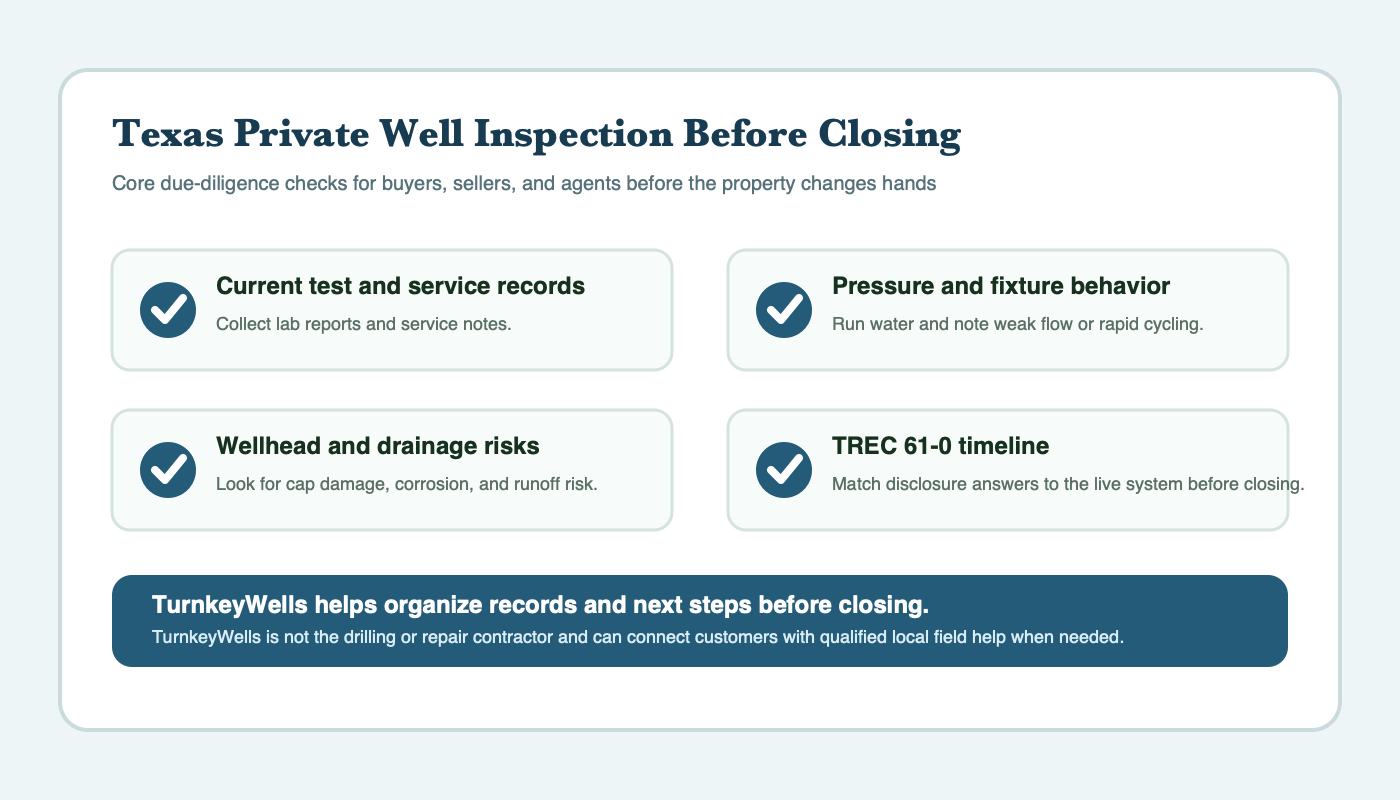
- Ask for recent certified lab water-test results, especially bacteria, nitrates, pH, and total dissolved solids.
- Run water at several fixtures and note weak pressure, inconsistent flow, pump short cycling, or air sputtering.
- Inspect the visible wellhead for cap damage, casing corrosion, runoff risk, standing water, or obvious neglect.
- Review pump, pressure tank, pressure switch, and filtration service invoices instead of relying on memory.
- Ask whether the property has any plugged, abandoned, shared, or older unused wells that affect the deal.
- Match the physical condition and repair history against the seller’s answers on the disclosure paperwork.
- Confirm who is expected to repair, credit, disclose, or document an issue before closing.
A smooth inspection does not mean every component is new. It means the system is understandable. Sellers lose leverage when they wait until the option period is nearly over to gather the well file.
Records Matter Almost as Much as the Hardware
A private well file should show more than one clean kitchen faucet. Buyers should look for water-test history, pump or tank receipts, driller reports if available, and any notes on prior repairs or well work. If the seller says the pressure tank was replaced last year, there should usually be an invoice. If the well was shocked, serviced, deepened, or evaluated after a water-quality issue, the paper trail matters.
Missing paperwork does not automatically mean the well is bad. It means the buyer has less proof and more risk. That is where a Free Well Check helps. Public well records and related property context can tell buyers and sellers whether the file is incomplete because the system is simple, or incomplete because nobody kept up with it.
What the Inspection Should Notice in Real Time
During the option period, somebody should actually run the water, watch the gauge behavior, and inspect the visible equipment area. A pump that starts every few seconds, fixtures that spit air, or pressure that falls apart during ordinary use may point to a pressure-tank problem, a leak, a low-yield well, or another mechanical issue. Those are not the same risk, and buyers should not guess which one they are inheriting.
If the property already shows a symptom, compare it with the more specific TurnkeyWells guides on low water pressure from a private well, air sputtering from faucets on well water, and signs an old water well is failing. That symptom-first review helps the buyer decide whether the issue looks small, neglected, or likely to keep escalating.
When Water Testing Should Be Non-Negotiable
Buyers should not accept taste, smell, or a seller’s reassurance as proof that the water is fine. Testing should be fresh when the property has flood exposure, nearby septic or livestock pressure, storm-triggered water changes, staining, sulfur odor, or recent repair work. At minimum, buyers should consider total coliform bacteria, E. coli, nitrates, pH, and total dissolved solids as a baseline panel.
TurnkeyWells does not provide medical advice. If the well raises a water-safety concern, the right next step is certified lab testing, local health department guidance where appropriate, and qualified water well or water treatment professionals.
Texas-Specific Inspection and Disclosure Questions
Texas deals add another layer because the inspection and the disclosure side need to line up. The TREC Form 61-0 Texas water disclosure guide explains the reporting side, but the form does not replace a real look at the live system. If the property is in a Groundwater Conservation District, future repair, replacement, or new-well planning may also depend on local rules. Buyers should understand whether the current system looks sustainable or whether future well work is already looming.
That is one reason the Pre-Drill Intelligence Report matters when the existing well may be near replacement or when the file suggests a bigger groundwater problem than a simple repair. Nearby well depth patterns, local drilling context, and surrounding records can change the economic picture quickly.
Buyer and Seller Negotiation Questions
Not every well issue should be solved the same way. Sometimes the right move is a targeted repair before closing. Sometimes it is updated testing and better paperwork. Sometimes it is a credit, a price adjustment, or a more serious evaluation because the symptom points toward a broader performance problem.
Sellers benefit from the same discipline. A seller who gathers the lab results, service invoices, and repair notes before listing is in a much stronger position than a seller who reacts after the buyer starts finding holes.
Where TurnkeyWells Fits
TurnkeyWells is not the drilling or repair contractor. TurnkeyWells helps buyers, sellers, owners, and agents organize the records, understand the likely risk points, and decide what needs to be checked next. That can include reviewing public well-record context, clarifying whether the current issue looks mechanical, sanitary, documentation-related, or planning-related, and connecting customers with qualified local help when field work is needed.
The cleanest closing files are the ones where the well story is already assembled before the pressure hits. Inspect the visible system, test the water, line up the records with the disclosure, and decide whether the next step is a simple correction or a bigger well-planning conversation.
Inspect the Well Before the House Is Yours
If a Texas property depends on a private well, TurnkeyWells can help review the inspection question, organize the records, and connect you with qualified local help when field work is needed. It is much easier to sort this out before closing than after the next water problem becomes your problem.
Start with a Free Well CheckNeed help reviewing the well before closing?
Contact TurnkeyWells and we can help review the issue and connect you with licensed local help.
Tell us what the buyer, seller, or inspector is seeing, where the Texas property is located, and whether the concern is about missing records, water quality, pressure, disclosure, or the closing timeline. TurnkeyWells can help review the issue, inspection question, or maintenance concern and connect the visitor with a licensed water well professional in their area when field work is needed.
TurnkeyWells helps organize records, next steps, and qualified local referrals. TurnkeyWells is not the drilling or repair contractor.