Texas Private Well Maintenance
Private Well Maintenance Schedule by Age in Texas
A private well does not need the same maintenance conversation at year two that it needs at year twenty. In Texas, the right schedule changes with well age, service history, storm exposure, water-quality drift, and whether a buyer or seller needs clean records before the next decision gets expensive.
Quick Answer
First five years
Focus on documentation, yearly water testing, cap and drainage condition, and a clean baseline for the pump and pressure system.
Midlife wells
Watch for pressure drift, sediment, faster filter loading, repeated service calls, and missing records nobody thought to save.
Older wells
Assume age raises the value of inspection, lab testing, pump history, and nearby drilling context before a repair or sale forces the question.
Buyer or seller angle
The well file should make sense before closing. Current condition belongs in the same conversation as TREC Form 61-0, repair notes, and test results.
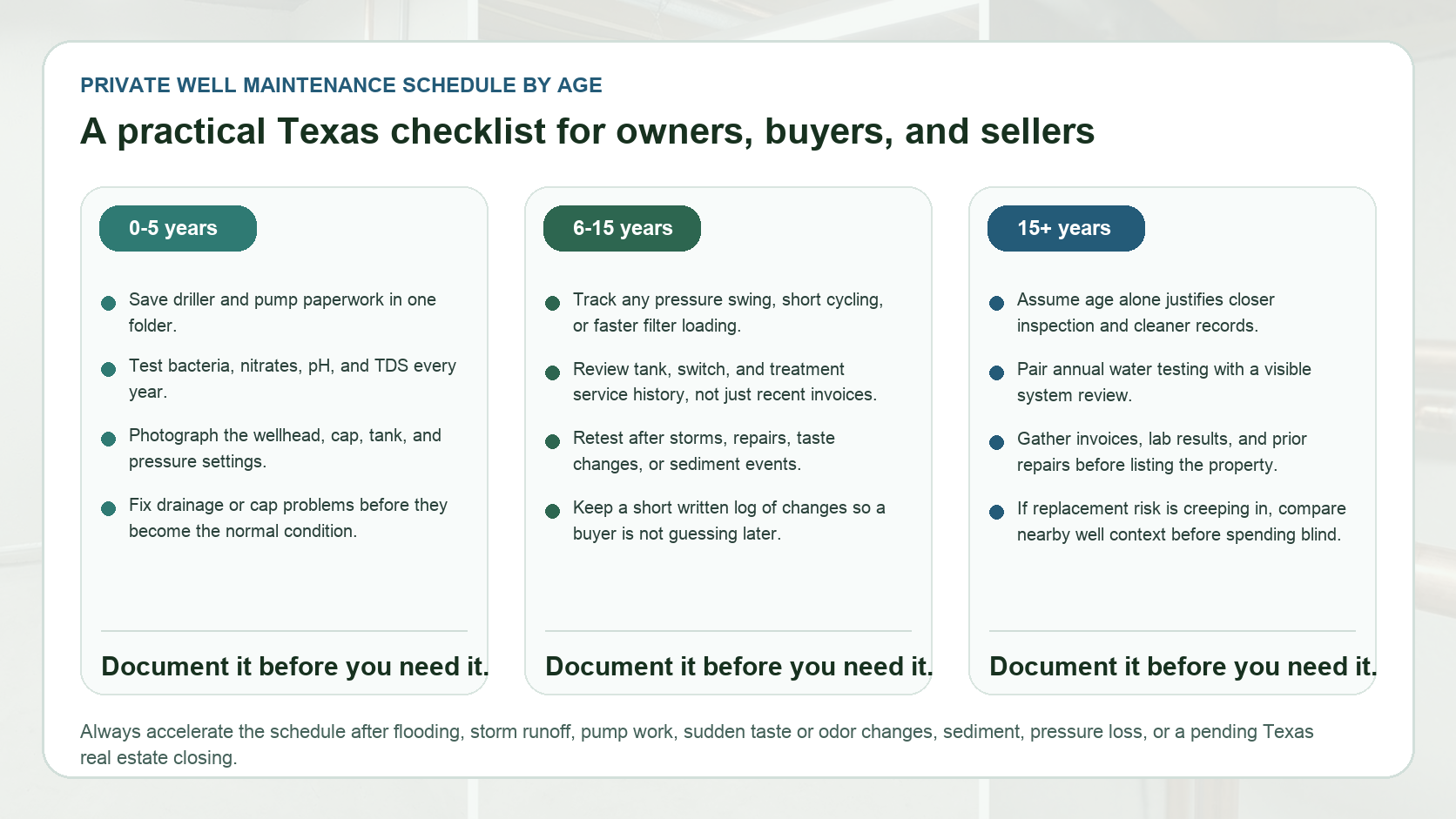
The Schedule Changes Because the Risk Changes
Most private well owners are told to test yearly and call someone when the water quits. That is not wrong, but it is incomplete. A new or recently rebuilt well needs disciplined recordkeeping more than major repair planning. A midlife well needs a sharper eye on pressure behavior, treatment equipment, and what the water has started doing differently. An older well needs a more skeptical maintenance routine because memory is usually cleaner than the paperwork.
That is especially true in Texas. Heat, lightning, heavy rain, drought, iron, sulfur complaints, livestock pressure, septic runoff, and long rural driveways all add wear or uncertainty in different ways. The goal is not to over-maintain the system. The goal is to catch the cheap problems while they are still cheap and to build a file that makes sense when a buyer, seller, lender, or well professional asks real questions.
What to Do in the First Five Years
The first phase is about baseline. Save the driller report, pump information, water test results, and photos of the wellhead, pressure tank, and controls while everything still looks normal. Test the water every year for total coliform bacteria, E. coli, nitrates, pH, and total dissolved solids. If the property has a specific symptom, add the right follow-up panel instead of pretending the yearly baseline answers every question.
This is also when drainage and sanitation habits get set. Keep runoff moving away from the wellhead. Do not let landscaping, scrap material, feed, or chemical storage crowd the cap. If a storm exposes a low spot around the casing, fix it early. That is much easier than explaining later why muddy stormwater kept collecting at the well every spring.
What Midlife Wells Usually Need
Six to fifteen year maintenance checkpoints
- Compare annual lab results instead of treating each test as a one-off.
- Watch for short cycling, slower pressure recovery, air sputtering, or new sediment.
- Review pressure tank, switch, filter, and treatment service history for recurring patterns.
- Retest after flooding, pump pulls, cap damage, or any sudden change in taste or appearance.
- Write down repairs while they are fresh so a later buyer is not left with hearsay.
Midlife wells are where owners start paying for assumptions. A tank may have been replaced, but no one remembers the pressure settings. The water may have been brown after rain twice, but no one saved the lab reports. A pressure issue may have shown up every dry summer, but the owner only remembers that a technician “got it running again.” That is the stage where the record should become more disciplined, not less.
How the Plan Changes for Older Wells
Once a well is older, the schedule should assume that age itself is relevant even when the water still works. That does not mean every older well is failing. It means older systems deserve a cleaner annual review of the visible wellhead, casing, pressure system, and water-quality record. If the property may need a new well in the next few years, the owner should understand nearby depth and groundwater context before a breakdown forces a rushed decision. That is where the Pre-Drill Intelligence Report becomes useful, especially when the system is already showing warning signs.
If the well is showing classic decline symptoms such as lower pressure, sediment after restart, repeated pump or switch issues, or a growing mismatch between repairs and results, compare those patterns with our guides on signs an old well is failing and annual private well inspection checklists. Those pages help separate normal upkeep from the early stages of a bigger well-planning problem.
What to Inspect or Document Every Year
Every age bracket still shares a core routine. Inspect the well cap, visible casing, drainage around the wellhead, pressure gauge behavior, pressure tank condition, exposed electrical components, filter housings, and any treatment equipment that has started needing more attention. Save annual lab reports, pump invoices, pressure tank work, chlorination notes, and any contractor findings in one place. A file full of missing years is its own warning sign.
If the water raises a safety question, do not rely on taste or color to clear it. Use certified lab testing, follow local health department guidance where appropriate, and work with qualified water well or water treatment professionals. TurnkeyWells does not provide medical advice, and TurnkeyWells is not the drilling or repair contractor.
Texas Stressors That Should Accelerate the Schedule
Some events should move the schedule up no matter how old the well is. Floodwater near the wellhead, major storm runoff, wildfire cleanup, pump replacement, cap damage, a pressure tank failure, recurring sediment, rotten-egg odor, metallic taste, or brown water after heavy rain all justify faster follow-up. In Texas, those events are common enough that a once-a-year reminder on the calendar is not a complete plan by itself.
If you do not know what public records already exist for the property, start there. A Free Well Check can help owners, buyers, and sellers review the public side of the file before they assume the well story is straightforward. That is often the fastest way to figure out whether the problem is mainly maintenance, mainly documentation, or part of a larger groundwater decision.
Why Buyers and Sellers Should Care About an Age-Based Schedule
Real estate pressure exposes weak maintenance habits fast. Buyers want current test results, service invoices, and a believable explanation of what has been happening with the well. Sellers want to avoid discovering during the option period that nobody can document the last test, the last tank replacement, or why the water changed after storms. An age-based maintenance schedule helps because it turns the well into a file with a pattern instead of a mystery with anecdotes.
The physical condition of the well and the paperwork should line up. The TurnkeyWells TREC Form 61-0 guide covers the disclosure side. Maintenance records, lab results, and visible system condition cover the current-performance side. Together they give buyers and sellers a more honest picture of whether the next step is normal upkeep, a focused repair, or a deeper planning decision.
Where TurnkeyWells Fits
TurnkeyWells helps property owners organize records, understand likely next steps, and connect with qualified local help when field work is needed. TurnkeyWells is not the drilling or repair contractor. The role is to help people understand whether the question is about testing cadence, maintenance history, inspection, nearby well context, or a larger replacement decision before the wrong assumption gets expensive.
Use the Well’s Age to Get Ahead of the Next Problem
TurnkeyWells can help review the maintenance question, organize the records, and connect Texas property owners with licensed local water well professionals when field work is needed. A clean schedule beats an emergency every time.
Start with a Free Well CheckNeed help sorting out a maintenance schedule or older well question?
Contact TurnkeyWells and we can help review the issue and connect you with licensed local help.
Tell us what is happening with the well, how old the system is, where the Texas property is located, and whether the concern is about annual upkeep, buyer or seller due diligence, testing, or a bigger replacement question. TurnkeyWells can help review the issue, inspection question, or maintenance concern and connect the visitor with a licensed water well professional in their area when field work is needed.
TurnkeyWells helps organize records, next steps, and qualified local referrals. TurnkeyWells is not the drilling or repair contractor.