Produced Water and West Texas Data Centers: What Landowners Should Verify
Chevron and Microsoft just put off-grid AI power, brackish groundwater, and produced-water reuse in the same West Texas conversation. That does not mean the water question is solved. It means the questions got more technical.
Produced water is becoming the newest reassuring phrase in Texas data-center water talk. It deserves a more skeptical reading than that.
West Texas has real reasons to explore reuse. AI power demand is exploding. Freshwater is limited. Oil and gas operations already generate enormous wastewater volumes. Treated reuse could reduce disposal pressure and create a new industrial water source. That is the upside case, and it is worth taking seriously.
But a produced-water headline can hide the exact questions a landowner, buyer, driller, or local official still has to ask: what water is actually being used on day one, what part of the project needs it, who regulates the treatment and end use, whether brackish or fresh groundwater is still in the stack, and what happens in a county with little or no groundwater oversight.
Produced water should be treated as a due-diligence variable, not a magic phrase. It may reduce freshwater pressure over time. It does not erase the need to verify source water, treatment limits, power-plant operations, backup supply, and local groundwater rules before assuming a nearby project is water-light.
What changed in June
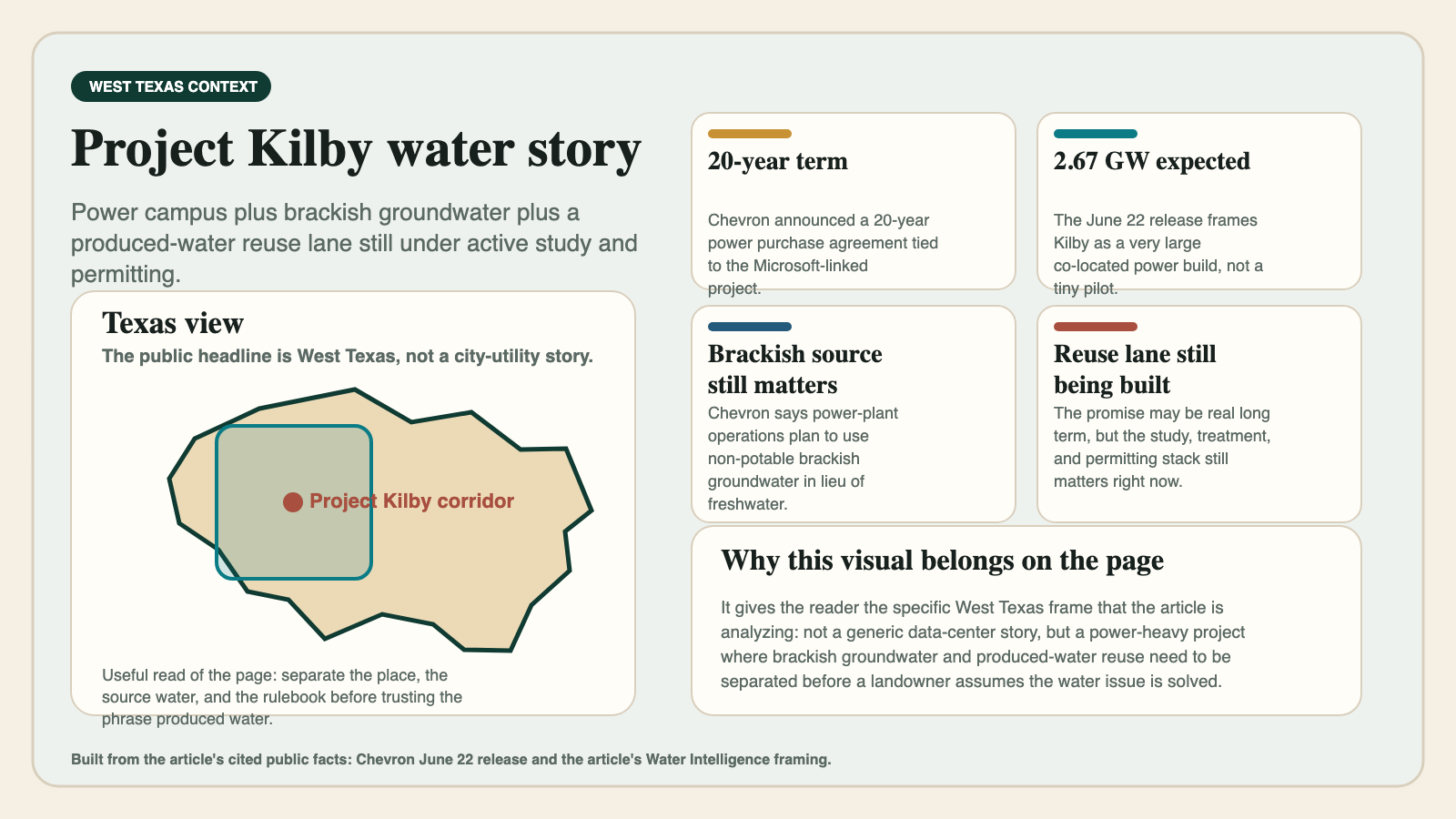
Chevron announced on June 22 that a wholly owned subsidiary, Energy Forge One, signed an agreement with Microsoft to develop a co-located power facility in West Texas under a 20-year power purchase agreement. Chevron says Project Kilby is expected to deliver about 2.67 gigawatts of capacity in phases, with first power anticipated in 2028 if the project reaches final investment decision.
The most important water line in Chevron’s release is not the AI branding. It is the operating-water sentence. Chevron says that, in lieu of freshwater, Kilby plans to use non-potable brackish groundwater sources for power-plant operations. The company also says it is working to advance solutions for reuse of produced water from oil and gas operations.
That is a meaningful shift from the usual city-supply data-center story. But it is still a layered water story, not a solved one. Brackish groundwater is still groundwater. Produced water reuse is still a developing treatment and permitting lane. A power campus can also use water differently from the data hall it serves. A landowner should want all of those pieces separated before believing the simple version.
Current Signal
Produced water is not just another recycled-water story
Produced water is a byproduct of oil and gas production. It is not simple municipal reclaimed water. It can contain high salt loads, heavy metals, naturally occurring radioactive material, and a moving mix of chemicals that varies by field, operator, and treatment chain. That does not make reuse impossible. It does mean the words “treated reuse” need more explanation than a developer brochure usually gives.
The Railroad Commission’s January 2024 pilot framework makes that point clearly. It says operators can seek authorization to study beneficial reuse of treated produced water, but the pilot work is about treatment effectiveness, storage, testing, documentation, and controlled evaluation. The RRC also says treated fluid will not be allowed to discharge to surface water during those pilot studies. That is not the language of a mature, frictionless supply chain. It is the language of a state still building the lane.
Texas Tech’s Produced Water Consortium says the same thing from the research side. The consortium was established by Senate Bill 601 in 2021 to study the economics and technologies related to beneficial uses of produced water, including environmental and public-health considerations, and to provide guidance on permitting and testing standards. That is valuable progress. It is also a reminder that the regulatory and scientific work is still active, not finished.
Why the rule split still counts
EPA’s Water Reuse Action Plan 2.0, launched in April, openly frames water reuse as part of the country’s AI, industrial, and energy buildout. EPA says reuse should help support data-center cooling, technology manufacturing, and energy development. That makes policy sense for a water-stressed growth state like Texas.
At the state level, the rulebook is split. The RRC has been working on produced-water recycling pilot studies. TCEQ is the agency developing the broader land-application permitting framework for treated produced water under state law. Media coverage in June reported that the proposed rule lane could reach uses such as industrial cooling, with permit-specific evaluations and monitoring requirements. That means a future project may touch more than one regulator and more than one kind of water standard.
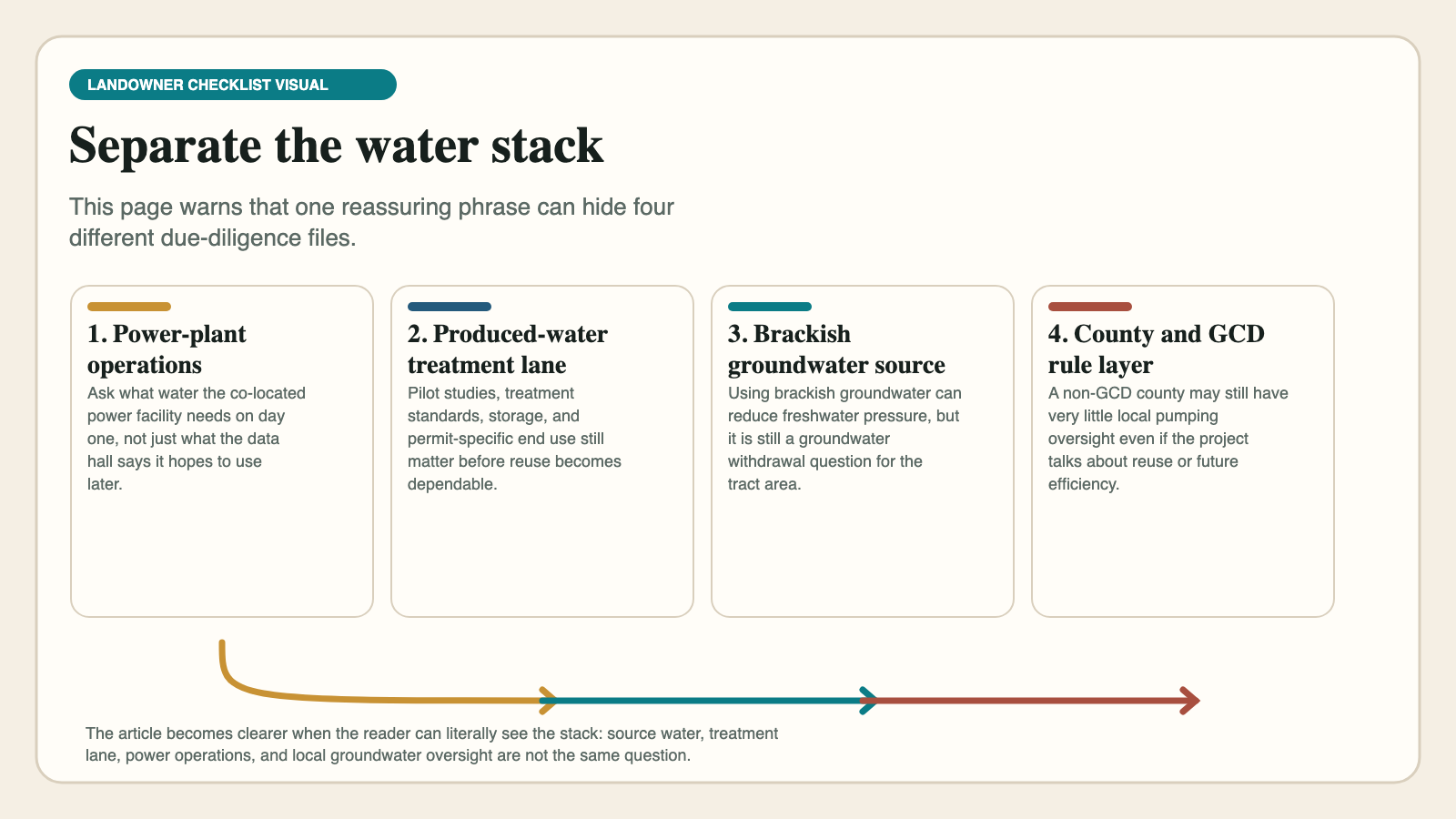
The landowner version of that split is simple: do not ask only whether a project “uses produced water.” Ask whether produced water is the primary source, a future aspiration, a seasonal supplement, or a pilot-stage option layered on top of brackish groundwater, utility service, or backup freshwater withdrawals.
No municipal-water story is not the same as no private-well risk
The June House hearing on Texas data-center water use made the information gap painfully obvious. Texas Public Radio reported that only about 17% of the 341 surveyed facilities had responded to the state’s water survey by the time of the hearing. KWTX reported the Public Utility Commission had responses from 28 companies representing 92 facilities. That is not enough visibility for a fast-growing industrial load.
The sharper problem came when lawmakers asked about counties without a groundwater conservation district. Texas Public Radio reported that Temple McKinnon of the Texas Water Development Board confirmed that, in a county without a GCD, there may be no local entity regulating how much groundwater a data center can pump. That is critical because a project can talk about reuse, closed-loop cooling, or future produced-water solutions while still sitting in a county where local groundwater withdrawals have almost no active local referee.
For West Texas property owners, that means the real risk file is broader than one facility’s marketing line. It includes county district status, aquifer context, nearby well history, project phasing, power-plant water use, backup water planning, and whether the most heavily used water source is the one being advertised in public.
What West Texas owners and buyers should verify
- Primary operating water: Is the actual day-one source brackish groundwater, municipal supply, treated produced water, surface water, or a mix?
- Project split: How much water is tied to the data hall itself versus the co-located power plant, auxiliary cooling, construction, dust control, fire suppression, and emergency backup operations?
- Treatment chain: Who is treating the produced water, what quality target is being met, and what regulator governs the intended end use?
- County oversight: Is the tract inside a groundwater conservation district, and if not, what local limit exists on large groundwater withdrawals?
- Nearby well evidence: What do reported domestic, stock, irrigation, industrial, and plugged wells show around the property, and are they drawing from the same aquifer context?
- Phase change risk: Does the water story stay the same after expansion, or does a future phase assume more groundwater, more treatment capacity, or different cooling conditions?
A Free Well Check can organize the nearby record trail first. If the tract may need a new well, a Pre-Drill Intelligence Report is the better next step because it ties nearby reported depths, plugged wells, aquifer signals, and district context back to one address.
See whether the local file supports the water story being told around the property.
Rule layerCheck GCD status before assuming local guardrails existCounty line, district line, and aquifer context can change the risk more than the headline does.
Bottom line
Produced water may become a real part of the Texas AI infrastructure story. That would be meaningful for a water-stressed state. But today it is still a developing treatment, research, and permitting lane wrapped inside a broader project-water stack that can include brackish groundwater, power-generation demand, and backup supply questions.
For West Texas landowners, the disciplined move is not to dismiss produced water and not to trust it blindly. Verify what the project actually uses, what part of the system uses it, who regulates it, and whether the local groundwater rulebook is strong enough to hold if the glossy story changes after the first phase.
- Chevron, June 22, 2026, on Project Kilby, the Microsoft power agreement, brackish groundwater for power-plant operations, and the company’s produced-water reuse language.
- EPA, April 16, 2026, on Water Reuse Action Plan 2.0 and reuse support for AI, data-center cooling, industry, and energy development.
- Railroad Commission of Texas, January 10, 2024, on pilot studies, treatment testing, and the no-surface-discharge limit during pilot work.
- Texas Produced Water Consortium at Texas Tech, on SB 601, research scope, and the consortium’s role in produced-water standards and guidance.
- Texas Public Radio, June 26, 2026, on the June House hearing, survey response gaps, and the lack of local groundwater regulation in non-GCD counties.
- KWTX/KCBD hearing coverage, June 24, 2026, on the 341 surveyed facilities, 17% response-rate frustration, and the PUC’s 28-company, 92-facility response set.
- The Texas Tribune, June 12, 2026, on TCEQ’s developing regulatory framework for treated produced water and the industrial-cooling rule context.
Media, source, or interview requests: contact TurnKey Wells about Texas groundwater, private wells, aquifers, and water-use research.