Texas Private Well Maintenance
Winterizing a Private Water Well in Texas
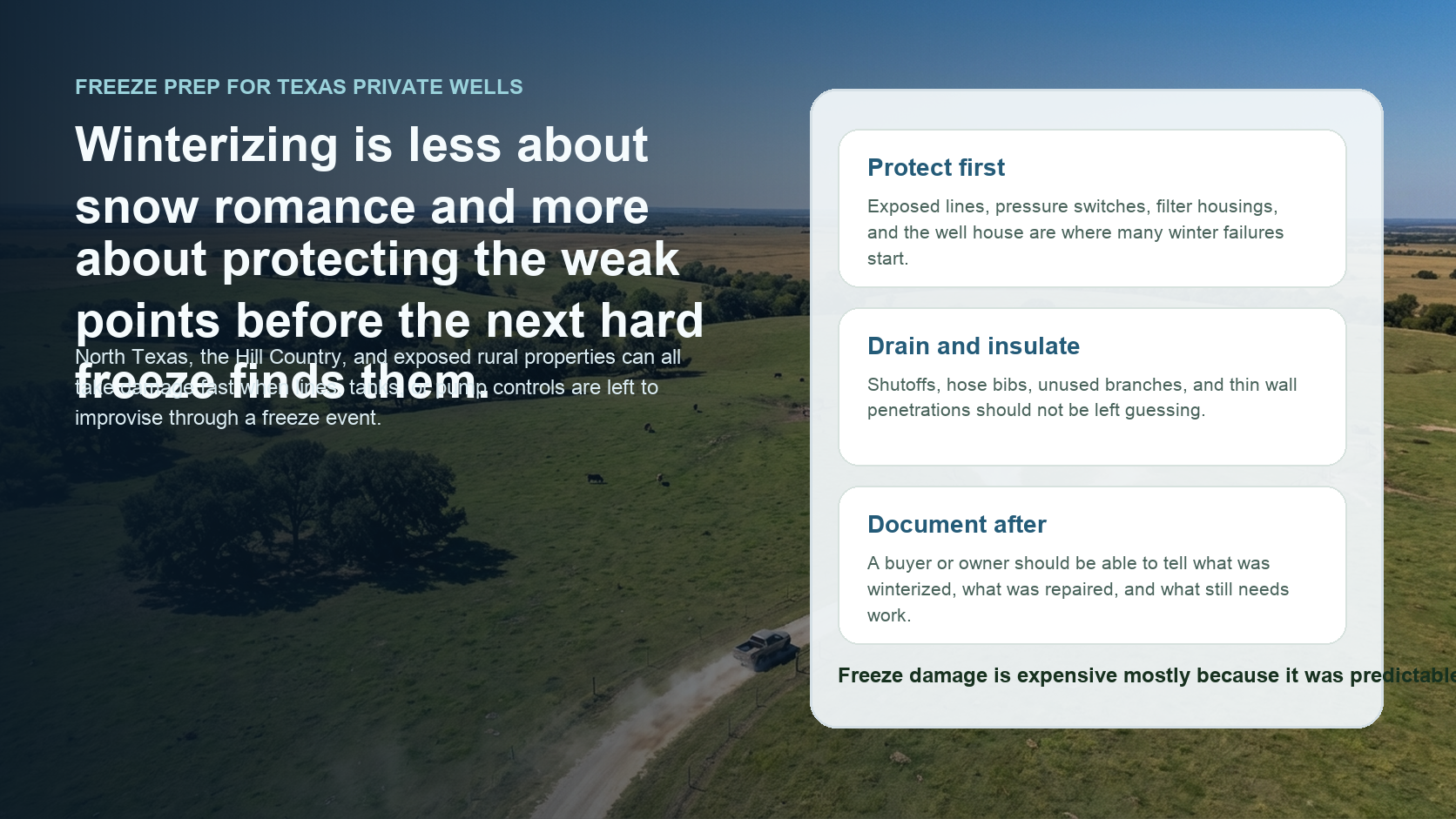
Texas does not need a long snowy season to crack exposed lines, split filter housings, freeze pressure controls, or leave a seller explaining a repair bill right before closing. Winterizing means protecting the weak points before the next hard freeze does the inspection for you.
Quick Answer
Most common weak points
Exposed lines, pressure switches, filter housings, thin well-house walls, poorly sealed doors, and forgotten hose branches.
Texas freeze reality
Short hard-freeze events can do real damage because many systems were built for heat first and insulation second.
Best timing
Inspect and prepare before the first strong cold front, then recheck when a severe freeze watch hits.
Buyer and seller angle
Freeze repairs, invoices, and current condition notes belong in the file before the option period starts shrinking.
Why Winterizing Still Matters in Texas
Texas well owners sometimes treat freeze prep like a North-only problem until a pressure switch locks up, a filter housing splits, or a line in the well house turns into a leak the morning after a hard front. The state is warm most of the year, but that can be the trap. A lot of private-well setups were built around heat, open-air utility spaces, and casual assumptions about winter. When the cold finally lands, the vulnerable parts are often the ones no one looked at in October.
North Texas, the Hill Country, the Panhandle, and exposed rural properties can all take hits first, but even Central Texas and Gulf Coast properties get caught when the event is sharp enough. The right question is not whether the area usually stays warm. It is whether this specific well system has exposed plumbing, a drafty enclosure, weak insulation, or past freeze repairs that tell you where the next failure is likely to start.
What to Inspect Before the Weather Turns
Pre-freeze inspection list
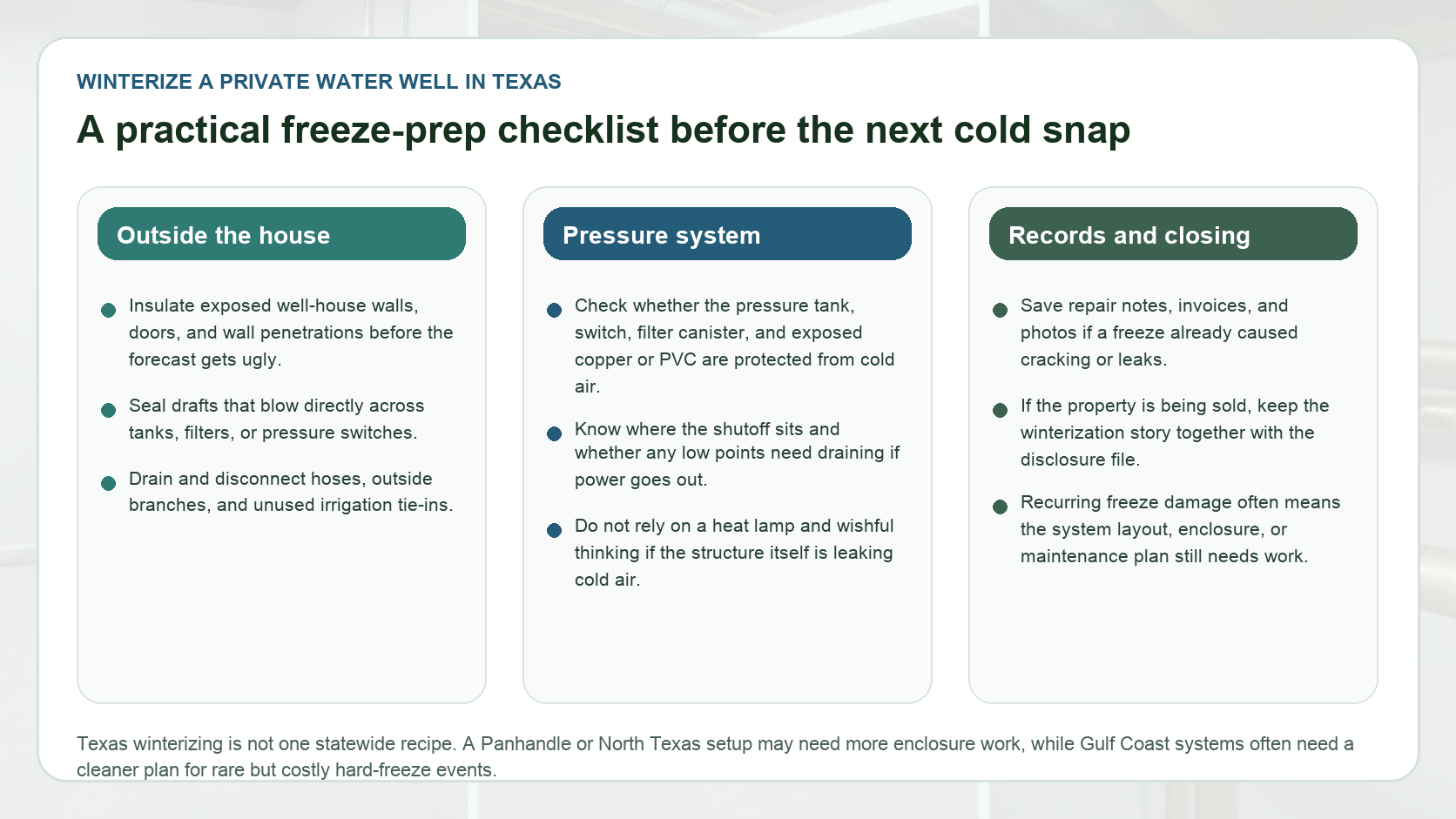
- Look at the well house or enclosure as a structure, not just a box. Drafts, missing insulation, loose doors, and open wall penetrations matter.
- Trace every exposed line you can see, especially near outside walls, slab edges, hose connections, and unheated spaces.
- Check the pressure tank, pressure switch, filter canisters, treatment equipment, and valves for cold-air exposure.
- Drain and disconnect hoses, temporary water lines, and unused branches that hold water near freezing temperatures.
- Know where the shutoff is and whether any low points can be drained if a power outage or pipe break forces a quick response.
Owners who have already dealt with cap, casing, or runoff issues should not ignore those while focusing only on pipes. A stressed enclosure with poor drainage can leave the system open to both freeze damage and sanitary trouble. TurnkeyWells guides on well cap and casing problems and annual private well inspection checklists help frame that broader look.
The Pressure System Usually Tells the Story
A freeze does not have to break the pump itself to create a bad week. Often the first damage shows up in the pressure system. A frozen or cracked filter housing, a split line near the tank, a pressure switch exposed to cold air, or a small leak that turns obvious only when temperatures drop can all make the system behave like a bigger mechanical failure. That is why winterizing should include the pressure side of the setup, not just the visible outdoor plumbing.
If the well house is unfinished or loosely enclosed, treat the tank, controls, and filters as part of the freeze-risk map. Many owners assume a single heat lamp is a plan. Sometimes it is just a delay. If the structure leaks cold air from every side, the better fix is improving the enclosure and insulation before the next storm asks the system to defend itself again.
Texas-Specific Freeze Planning
Texas winterizing is rarely one statewide recipe. A Panhandle or North Texas property may need more serious enclosure work because freezes can last longer. Hill Country and Central Texas systems may face shorter cold windows but still get hit hard if the well equipment sits in a breezy outbuilding. Gulf Coast owners often assume they are safe until the rare event is severe enough to catch every unprotected weak point at once.
That is also why nearby well context matters when the existing system is aging or poorly laid out. If winter damage is part of a pattern and the well already has bigger performance questions, the Pre-Drill Intelligence Report can help owners understand whether they are protecting a basically sound system or spending money around a setup that may need deeper planning.
What a Professional Usually Checks
A qualified water well professional will usually look beyond insulation wrap. They want to know whether the enclosure is workable, where the exposed branches sit, whether the system has already been patched after prior freezes, how the tank and controls are mounted, and whether the owner can isolate the system quickly if something ruptures. They are also more likely to notice when the freeze issue is really a design or maintenance problem that will keep repeating.
TurnkeyWells is not the drilling or repair contractor. The value here is helping owners, buyers, and sellers understand the record side, the likely weak points, and the next-step questions before they call the wrong repair or miss a larger risk.
Buyers, Sellers, and the Disclosure File
Freeze damage shows up in transactions because buyers do not love mystery leaks, patched lines, or vague stories about what happened during the last cold snap. Sellers are in a much stronger position when they can show what was winterized, what was repaired, and whether the system has performed normally since. A buyer looking at a rural property in winter should ask direct questions about prior freeze events, exposed lines, well-house protection, and any replaced components.
The paperwork should line up with the physical system. If the property depends on a private well, the current condition and repair history belong beside the TREC Form 61-0 Texas water disclosure guide conversation, not floating around as verbal memory. A recent repair bill with no explanation is not a clean file. A short written history with invoices, photos, and testing where needed is better.
Water Safety After a Freeze Event
If a freeze caused a line break, enclosure failure, flooding around the equipment, or any condition that leaves the sanitary side in question, do not treat normal pressure as proof that everything is fine. For water safety issues, use certified lab testing, local health department guidance where appropriate, and qualified water well or water treatment professionals. TurnkeyWells does not provide medical advice.
After any repair, owners should also think about whether they solved the cause or only the visible damage. Replacing a cracked fitting is one thing. Leaving the same drafty setup in place is how the next freeze collects its own invoice.
Where TurnkeyWells Fits
TurnkeyWells can help review the maintenance concern, organize the property record, and connect customers with qualified local water well professionals when field work is needed. A Free Well Check is a practical first step when you need to understand the well-record side of the property before deciding whether the concern is routine winter prep, a repair-history issue, or part of a broader well-risk picture. TurnkeyWells helps organize records and next steps. TurnkeyWells is not the drilling or repair contractor.
Winterize the Weak Points Before the Next Hard Freeze Does It for You
TurnkeyWells can help review the maintenance concern, organize the records, and connect Texas property owners with licensed local water well professionals when field work is needed. Freeze damage is expensive mostly because it usually announces itself ahead of time.
Start with a Free Well CheckNeed help sorting out a freeze-prep or winter repair question?
Contact TurnkeyWells and we can help review the issue and connect you with licensed local help.
Tell us what the Texas property is dealing with, whether the concern is exposed plumbing, a drafty well house, pressure-system damage, a prior freeze repair, or a buyer-seller documentation question. TurnkeyWells can help review the issue, inspection question, or maintenance concern and connect the visitor with a licensed water well professional in their area when field work is needed.
TurnkeyWells helps organize records, next steps, and qualified local referrals. TurnkeyWells is not the drilling or repair contractor.