Texas Private Well Buyer Due Diligence
Buying a House With a Private Well: Red Flags in Texas
A private well is not automatically a problem in Texas, but a house gets riskier fast when the water system has warning signs, missing records, or unanswered inspection questions. Buyers should know what to check before the option period disappears and everyone starts guessing.
Quick Answer
Biggest buyer red flags
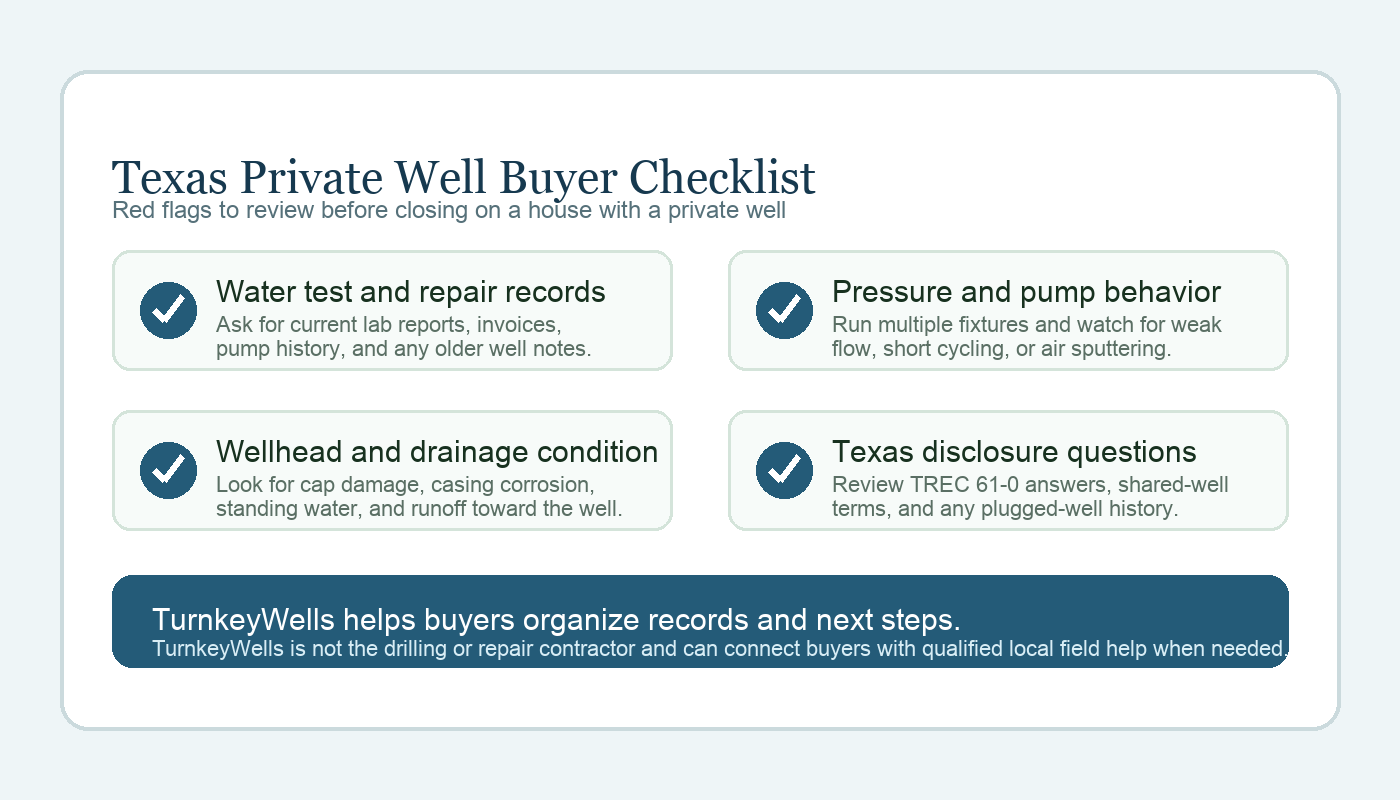
No recent water test, no repair history, weak pressure, visible drainage or casing issues, and vague answers about older wells on the property.
What to ask first
Who maintains the well, when it was last tested, what repairs were done recently, and whether any abandoned or plugged wells exist.
When to slow down
If the water changes after rain, the pump short cycles, pressure is inconsistent, or the seller cannot document the system, get more answers before closing.
Texas paperwork angle
The physical condition of the well and the disclosure questions on TREC Form 61-0 should be reviewed together, not as separate chores.
Why a Private Well Is Different From City Water
Buying a house with a private well is normal across rural Texas, small towns, ranch properties, and homes outside public-water service. The problem is not the existence of the well. The problem is buying into a system you do not understand. With city water, the utility owns the treatment and distribution side. With a private well, the property owner owns the risk, the maintenance, and the testing responsibility. A clean kitchen and a recent roof do not tell you whether the water supply is reliable, safe to use, properly documented, or one repair away from a closing dispute.
Red Flags Buyers Should Take Seriously
Private well warning signs before closing
- No recent certified lab water test for bacteria, nitrates, pH, and total dissolved solids.
- Pressure that drops during normal use, a pump that starts too often, or fixtures that sputter air.
- Cloudy, rusty, muddy, or bad-smelling water with no clear explanation or service record.
- Visible casing corrosion, a loose or damaged well cap, or drainage that lets rainwater collect near the wellhead.
- Seller answers that rely on memory instead of invoices, lab reports, driller records, or inspection notes.
- Evidence of old wells, shared-well arrangements, or plugged wells that no one has fully explained.
- A property story that points toward repeated repairs but no organized paperwork to prove what was done.
None of those items automatically kills the deal. The red flag is really the uncertainty. Buyers get burned when the file is thin, the timeline is short, and everyone starts using the word probably.
What to Inspect During the Option Period
Start with the basics you can observe safely. Run water at multiple fixtures. Watch whether pressure stays steady. Listen for a pump that clicks on and off too quickly. Look at the pressure tank area for rust, seepage, or makeshift repairs. Go outside and inspect the visible wellhead area. The cap should look secure and sanitary. Water should drain away from the casing, not pool around it.
If the property already shows symptoms, compare them with the more specific TurnkeyWells guides on low water pressure from a private well, signs an old water well is failing, and the annual private well inspection checklist. Those patterns help buyers separate a small maintenance issue from a deeper system concern.
Records Matter Almost as Much as Hardware
A private well file should tell a story. Buyers want to see recent water-test results, pump or tank invoices, any driller paperwork, and notes on known repairs. If the seller says the pressure tank was replaced last year, there should usually be a receipt. If the well was shocked, deepened, or pulled for service, there should be some record of it. If there is an abandoned well elsewhere on the tract, the buyer should know whether it was properly plugged.
This is where Texas transactions often get messy. A seller may have owned the property for years but still not have a well file together. That does not always mean bad faith. It does mean the buyer should stop treating the missing paperwork like a minor inconvenience.
Texas-Specific Due Diligence Questions
Texas buyers should look at the physical well condition and the disclosure side at the same time. The TREC Form 61-0 Texas water well disclosure guide covers the legal and transaction questions, but buyers still need to understand the live condition of the system that serves the house. If the property is inside a Groundwater Conservation District, local rules may also matter for future replacement, new drilling, or well registration.
That is one reason the Pre-Drill Intelligence Report can be useful before the house changes hands. If the current well may be nearing replacement, a buyer needs more than a repair estimate. Nearby well depth patterns, local drilling context, and record history help frame the real cost and risk of owning that property long-term.
When Water Testing Should Be Non-Negotiable
Buyers should not rely on taste, odor, or the seller’s reassurance to decide the water is fine. A private well should have current certified lab results, and fresh testing becomes even more important if the property has flood exposure, livestock, septic proximity, recurring discoloration, sulfur odor, or recent repair activity. At minimum, buyers should consider total coliform bacteria, E. coli, nitrates, pH, and total dissolved solids as a baseline.
TurnkeyWells does not provide medical advice. If the well shows a safety concern, the right next step is certified lab testing, local health department guidance where appropriate, and qualified water well or water treatment professionals. A closing deadline is a bad reason to skip the part that affects what comes out of the tap.
What a Professional Well Review Usually Checks
A qualified review typically looks at the visible wellhead, pressure behavior, pressure tank and switch condition, signs of leaks, recent service history, and whether the water symptoms point to a mechanical issue, a sanitary issue, or both. A buyer may also need clarity on whether the well is dedicated to the property, shared, or affected by an older unused well.
Seller Repair and Documentation Questions
Buyers should ask whether the seller is willing to fix a confirmed issue before closing or provide documentation that the problem was already addressed properly. Sometimes a pressure tank, cap, or plumbing repair is straightforward. Sometimes the better answer is a price adjustment or a more careful local review because the symptom may point toward a broader well-performance problem.
Either way, clear records make the conversation easier. A buyer is in a stronger position when the discussion is based on water tests, invoices, and inspection observations.
Where TurnkeyWells Fits
TurnkeyWells is not the drilling or repair contractor. TurnkeyWells helps Texas buyers, sellers, owners, and agents organize the records, understand the likely risk points, and decide what should be checked next. A Free Well Check is a practical first step when the buyer needs to know what public well information is already tied to the property, and TurnkeyWells can help connect customers with qualified local help when field work is needed.
Do the Well Due Diligence Before the House Is Yours
If a Texas property depends on a private well, TurnkeyWells can help review the records, clarify the red flags, and organize the next step before closing pressure turns uncertainty into your problem.
Start with a Free Well CheckNeed help reviewing a well before closing?
Contact TurnkeyWells and we can help review the issue and connect you with licensed local help.
Tell us what the buyer, seller, or inspector is seeing, where the Texas property is located, and whether the concern is about missing records, water quality, pressure, disclosure, or the option-period timeline. TurnkeyWells can help review the issue, inspection question, or maintenance concern and connect the visitor with a licensed water well professional in their area when field work is needed.
TurnkeyWells helps organize records, next steps, and qualified local referrals. TurnkeyWells is not the drilling or repair contractor.
Budget Before You Buy
A private-well red flag can turn into a real budget issue when the property needs a deeper replacement well, a larger pump, treatment, or more due diligence. Use the Texas water well drilling cost guide to frame the potential downside before closing.