State water planning is important in Texas, but it is not a property guarantee. The 2027 State Water Plan is a huge planning document built on regional inputs that can lag fast-moving data-center demand, local groundwater fights, and tract-specific well reality.
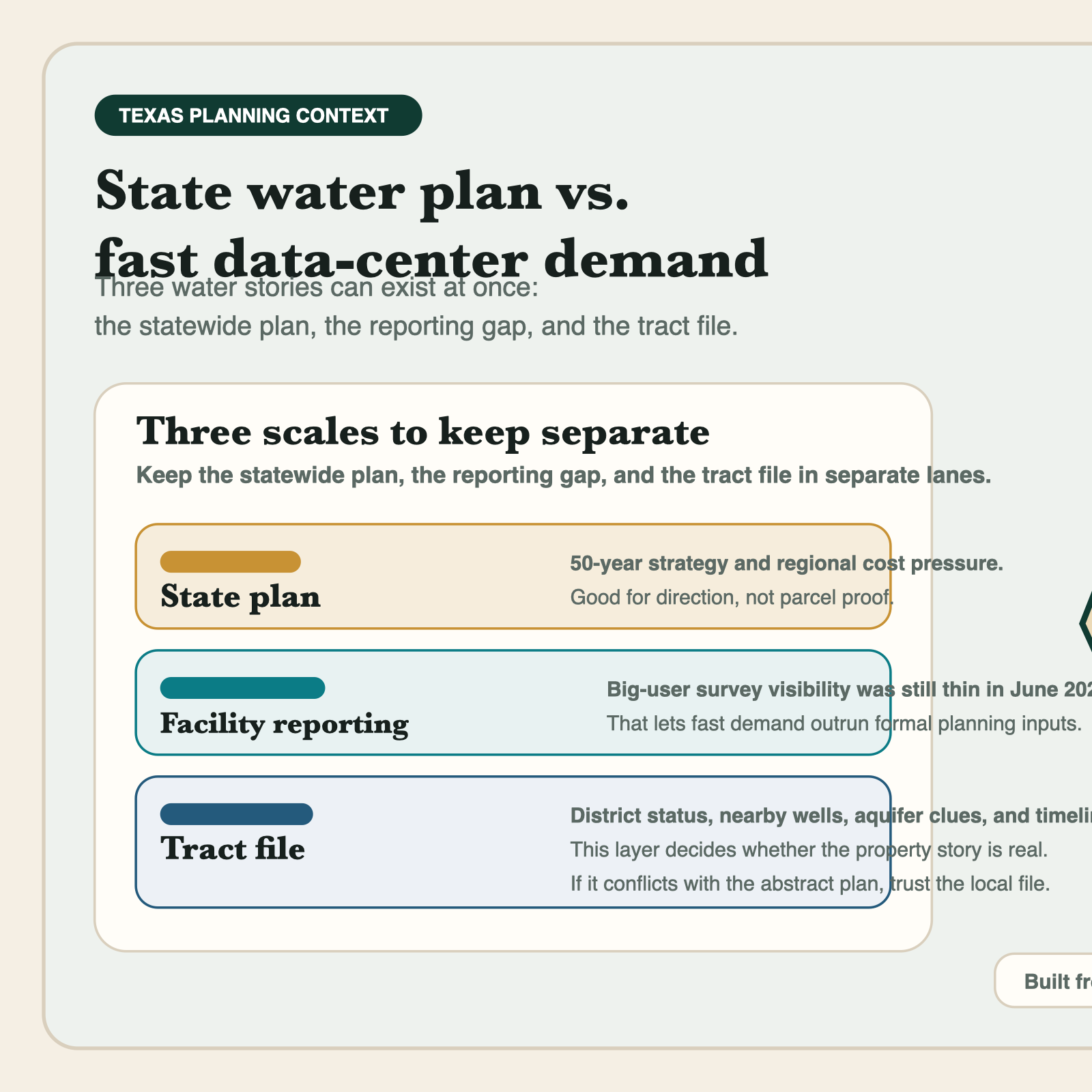
The Texas 2027 State Water Plan is important. It is also easy to overread if you are buying rural land or planning a private well.
The plan is the state’s long-horizon water roadmap. It rolls up regional planning assumptions, project lists, supply strategies, and infrastructure costs into one document that utilities, lawmakers, groundwater districts, engineers, and large users all watch. If you care about groundwater pressure, municipal expansion, aquifer management, or future drilling demand, it belongs on the radar.
What it does not do is answer a tract-level question by itself. A statewide plan cannot confirm whether the parcel you want is inside a groundwater conservation district, whether nearby wells tell a stronger story than county averages, whether an emerging industrial load shares the same aquifer, or whether a local source-water plan is still more slogan than engineering.
Use the State Water Plan as a pressure map, not a property guarantee. It is a strong place to understand where Texas thinks water stress, infrastructure cost, and supply strategy are heading. It is a weak place to assume a specific rural tract is safe to buy, easy to drill, or insulated from a large new water user.
Why the July planning window is important
TWDB’s 2027 State Water Plan page frames the document as the next official statewide planning cycle, and July 2026 board materials put that plan into an adoption window with public-comment review and final-plan discussion. The draft number attached to the plan is large: about $174 billion in water infrastructure needs over 50 years.
That number is important because it reminds buyers and owners that Texas is not planning around a solved water future. The plan is a sign that supply, treatment, storage, transmission, drought resilience, and groundwater management are expensive and uneven across regions. If a listing pitch treats water as simple, the statewide planning file is often the first clue that it is not.
But the same scope that makes the plan valuable also creates distance. It is built for statewide strategy and regional planning, not for one ranch gate, one homesite, one seller disclosure, or one domestic well budget.
Current Planning Signal
Where the data-center demand gap shows up
The most useful criticism of the plan is not that it is wrong. It is that planning cycles can lag fast-moving demand. That is especially true when a new class of large water and power users appears faster than official reporting systems mature.
That was already visible in 2026. Public hearing coverage said only a fraction of surveyed Texas data centers had responded to the first state water-use survey by late June. At the same time, lawmakers were still pressing agencies on a basic question: how much water are these facilities using, and where is it coming from?
For a rural buyer, that gap is important because the planning story and the local story can diverge. A regional plan may not fully reflect a specific proposal, a fast-tracked industrial load, a co-located power project, or a county with no local groundwater district. A brochure may say recycled water, produced water, or closed-loop cooling. The actual tract-level question is whether a nearby project still depends on groundwater, directly or indirectly, and whether any local institution is in position to measure or limit that demand.
That is why the State Water Plan is best used alongside more current signals. The AI data centers and Texas water guide helps translate the statewide reporting problem. The produced-water West Texas brief shows how a reassuring supply phrase can still leave unanswered groundwater questions. And the East Texas governance stories now live on the Water Intelligence hub show how district formation itself can become a due-diligence issue before drilling even begins.
What the plan still does well
The plan remains useful because it teaches scale. It tells you which regions already see water-supply pressure, where infrastructure costs are rising, and why local systems cannot be evaluated in isolation. If you are comparing counties, following groundwater policy, or trying to understand why an area keeps talking about reuse, pipeline projects, or new groundwater strategies, the plan gives that conversation a statewide frame.
It also gives buyers a better question set. Instead of asking whether Texas is planning for water in some general sense, ask whether the local assumptions behind a property actually match the local record. Is the tract inside a district? Do nearby submitted driller reports support the depth and yield story? Does the aquifer context line up with what a seller or broker is implying? Is there a new industrial or municipal demand signal that does not yet show up clearly in long-horizon planning language?
The statewide document is therefore most helpful when it pushes you down into local evidence, not when it tempts you to stay abstract.
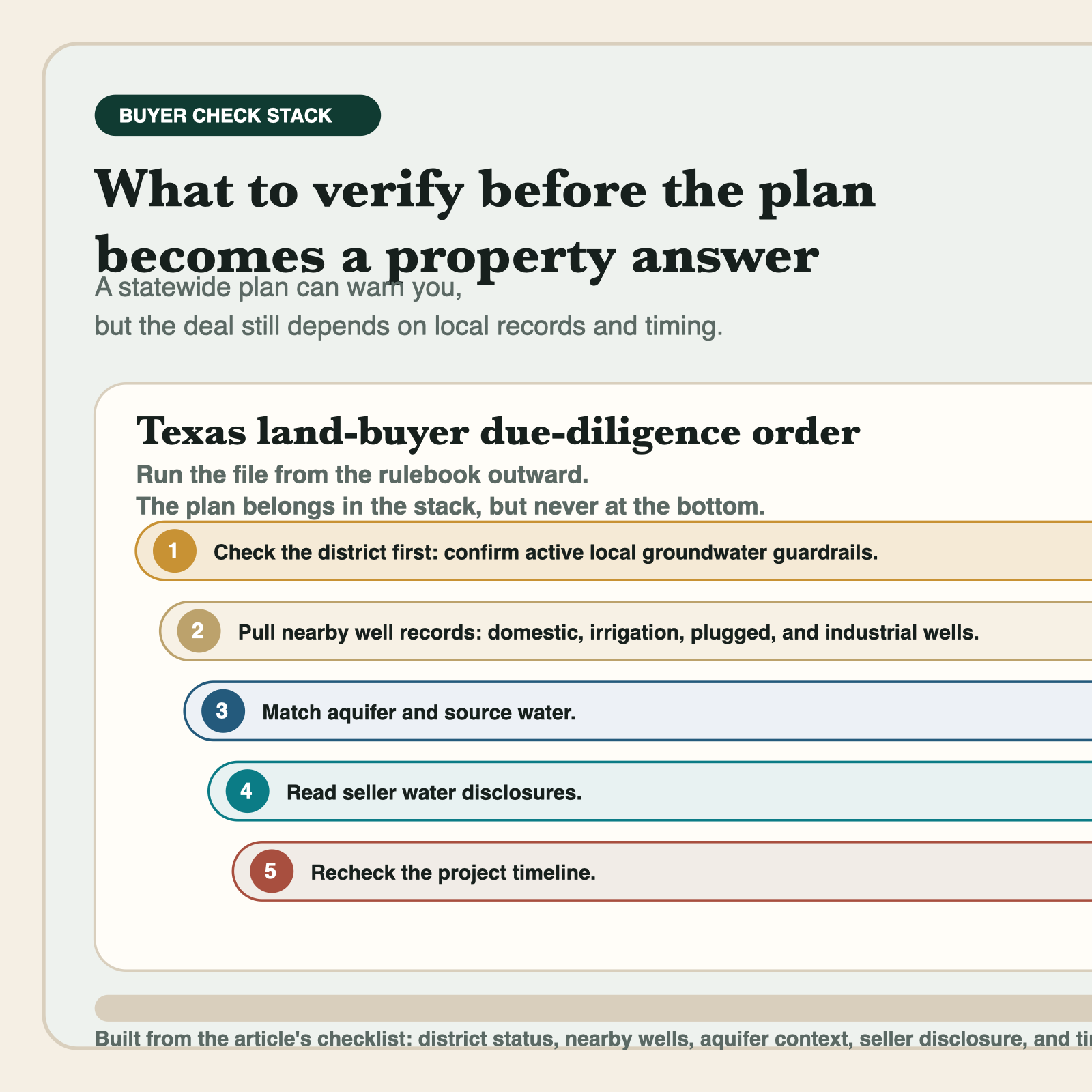
What buyers, owners, and agents should check before leaning on the plan
- Check the district first. Use the Texas Groundwater District Lookup before assuming a county has active local pumping guardrails.
- Review nearby well records. The Free Well Check is better than a county average when you need to know what nearby domestic, irrigation, plugged, or industrial wells actually show.
- Separate statewide pressure from parcel evidence. A plan can warn you that a region is stressed without proving your tract has no workable well option, and it can also leave out a local demand spike that can affect your property directly.
- Read seller paperwork with water in mind. The Texas water-disclosure guide is a better place to understand what should be documented before closing than a statewide planning summary.
- Use pre-drill research when the deal depends on a new well. A Pre-Drill Intelligence Report ties nearby records, aquifer context, district status, and warning signs back to one address.
- Keep the timeline honest. Ask whether the local project, user, or policy fight you care about moved after the planning inputs were assembled.
Separate comparable evidence from broad planning language before you trust a drilling assumption.
Keep readingFollow Water Intelligence for new planning and groundwater signalsUse current Texas water stories to update the statewide picture with fresher local pressure clues.
Bottom line
The 2027 State Water Plan is a serious document and a useful warning that Texas water risk is expensive, regional, and long-term. It should make buyers more careful, not more comfortable.
If a deal depends on a private well, do not stop at the statewide plan. Pair it with district status, nearby well records, current development pressure, aquifer context, and the actual wording of the closing file. That is how a broad planning signal turns into a defensible property decision.
Source notes
- Texas Water Development Board 2027 State Water Plan page, checked July 24, 2026, for the statewide planning context and plan-cycle framing.
- TWDB June 2026 board materials and TWDB July 2026 work-session materials, checked July 24, 2026, for the board-window timing and public-comment/final-plan discussion context.
- Public Utility Commission water-use survey FAQ, checked July 24, 2026, for the 2026 data-center reporting context.
- Texas Tribune, April 16, 2026, for statewide plan-coverage context and the draft long-range infrastructure figure.
- Texas Public Radio, June 26, 2026, and KCBD hearing coverage, June 24, 2026, for the 341-facility survey context, response-rate gap, and non-GCD oversight discussion referenced in this article.
- This brief is a practical planning and due-diligence explainer, not legal advice, engineering advice, or a drilling guarantee.
Media, source, or interview requests: contact TurnKey Wells about Texas groundwater, private wells, aquifers, and water-use research.