Texas Rule of Capture: What Rural Property Buyers Misunderstand About Owning Groundwater
Texas recognizes groundwater ownership in place, but that does not mean a rural buyer is automatically getting unlimited pumping rights, a productive aquifer, or a cheap well. The difference is important before closing.
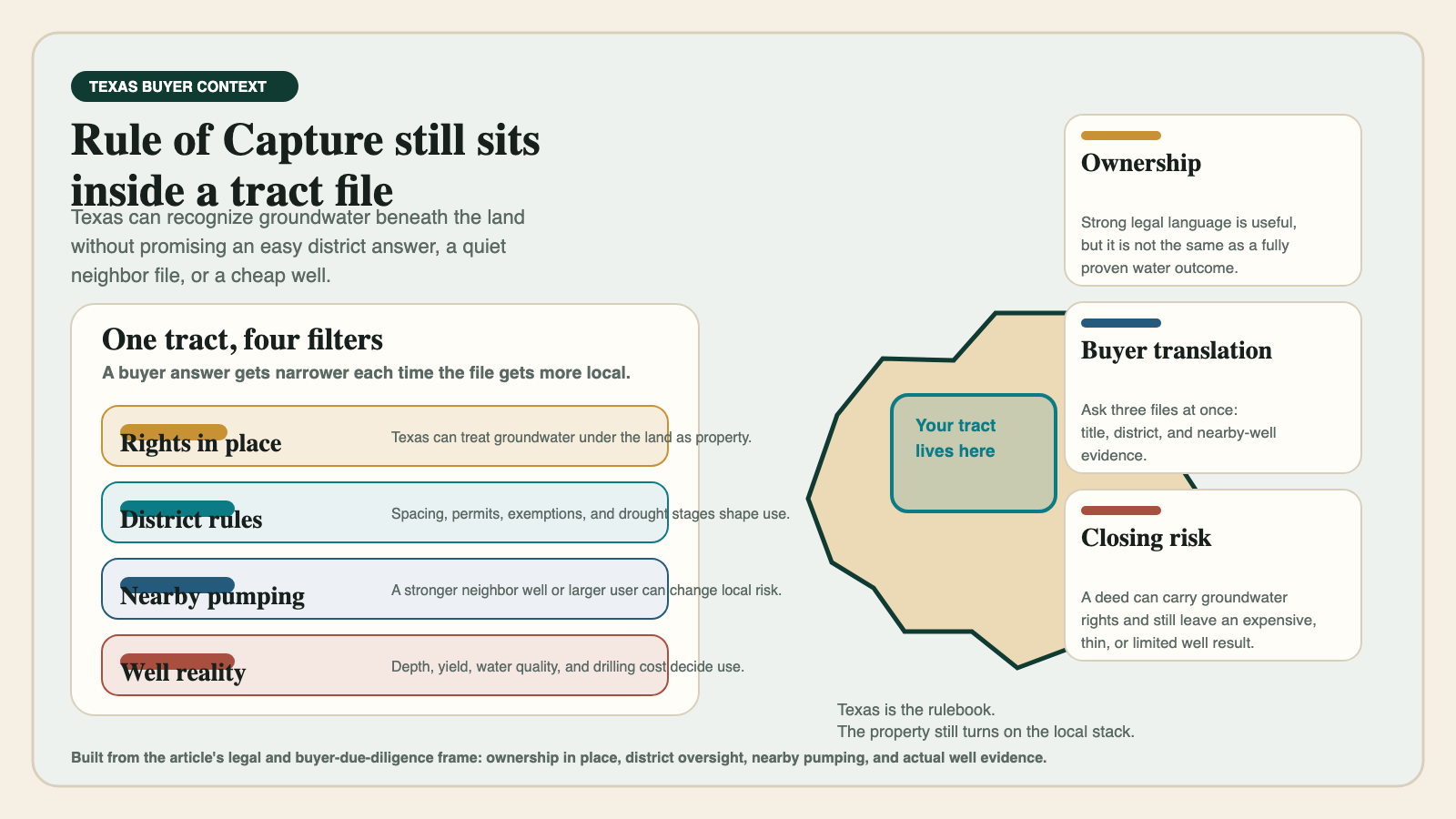
The short answer to the buyer’s question is this: Texas can recognize your ownership of groundwater beneath the land, and you can still buy a tract where the actual water situation is weaker, narrower, or more expensive than the sales pitch suggested.
That is the problem with the phrase “you own the water.” It sounds complete. It is not. For a rural buyer, the useful question is not whether Texas respects groundwater rights in the abstract. The useful question is what rights, rules, records, and physical well evidence apply to this tract before you close.
The rule of capture still applies in Texas. So do groundwater conservation districts, title history, nearby pumping, and the simple possibility that the aquifer under a property may be legally yours yet practically hard to use. That is why buyers should treat groundwater as both a rights issue and a due-diligence issue.
“Own the water” is not the same thing as “have a guaranteed well.” Texas law can favor landowner groundwater rights while still leaving a buyer with district rules, title complications, neighboring pumping risk, and expensive drilling uncertainty.
What the rule of capture actually means for a buyer
Texas groundwater law grew out of the rule of capture, with the old common-law idea that a landowner could generally produce groundwater captured from beneath the property without owing a neighbor just because that pumping affected the neighbor’s well. The rule remains central, and the Texas Supreme Court has not replaced it with a more buyer-friendly balancing test.
That does not mean “anything goes.” Texas Water Code Chapter 36 makes groundwater conservation districts the state’s preferred method of groundwater management, and the Texas Supreme Court has also recognized that groundwater in place is a real property interest. Put those ideas together and the buyer gets the real Texas answer: groundwater ownership is meaningful, but actual production can still be shaped by district rules, exemptions, spacing, permit conditions, and the physical aquifer.
For a property buyer, this is important because the legal slogan and the closing-file reality are often miles apart. You can buy land where the law respects groundwater ownership and still discover that the tract is inside a district with rules you never read, near a larger user you never noticed, or burdened by water-rights history that the listing never explained.
Four Buyer Mistakes This Article Tries to Fix
If you own it, can you pump as much as you want?
Sometimes buyers hear Texas groundwater talk and translate it into unlimited pumping rights. That is too blunt to be reliable. In some parts of Texas, the first practical rulebook to check is the local groundwater conservation district, not a one-line summary of the rule of capture.
A district may require registration, permits for non-exempt wells, spacing between wells, production limits, meters, reports, or drought-stage restrictions. The exact answer changes by district. It also changes by use. A domestic or livestock well may qualify for an exemption that does not apply to a subdivision, irrigation project, commercial use, or export-scale production.
This is why a buyer should run the tract through the Free Texas Groundwater District Lookup before relying on what a seller, agent, neighbor, or driller said from memory. Some tracts are inside a district, some are not, and district rules are not uniform statewide.
What if the neighbor pumps harder than you do?
This is where Texas groundwater law feels counterintuitive to many rural buyers. Legal ownership does not guarantee insulation from a nearby well. Under the traditional capture framework, neighboring pumping can still become your problem even when nobody crossed your fence line.
That is why nearby records become so important. Before buying rural land, do not stop at the question “Can I drill?” Ask what nearby domestic, irrigation, public-supply, or commercial wells are already in the area, what aquifer intervals they use, and whether larger users may be expanding nearby. The Free Well Check and the buyer-facing guide on how to read nearby Texas well records are stronger starting points than countywide averages or one-neighbor anecdotes.
The practical point is not to scare buyers into thinking every neighbor is a threat. It is to replace the lazy version of “you own the water” with a better question: what does the surrounding water-use pattern suggest about this tract’s actual risk?
Can groundwater rights be separated from the land?
Yes. This is one of the biggest blind spots in rural Texas deals. A buyer can focus so heavily on whether a tract has a well that they never ask whether groundwater rights were reserved, sold, leased, or otherwise separated from the surface estate in earlier documents.
That issue is not theoretical. Texas real estate disclosures now force more groundwater-rights questions into the transaction file. TurnKey Wells’ TREC Form 61-0 groundwater disclosure guide is useful here because it shows why sellers, buyers, title companies, and agents now have to talk more clearly about groundwater districts, third-party rights, shared arrangements, and prior transfers.
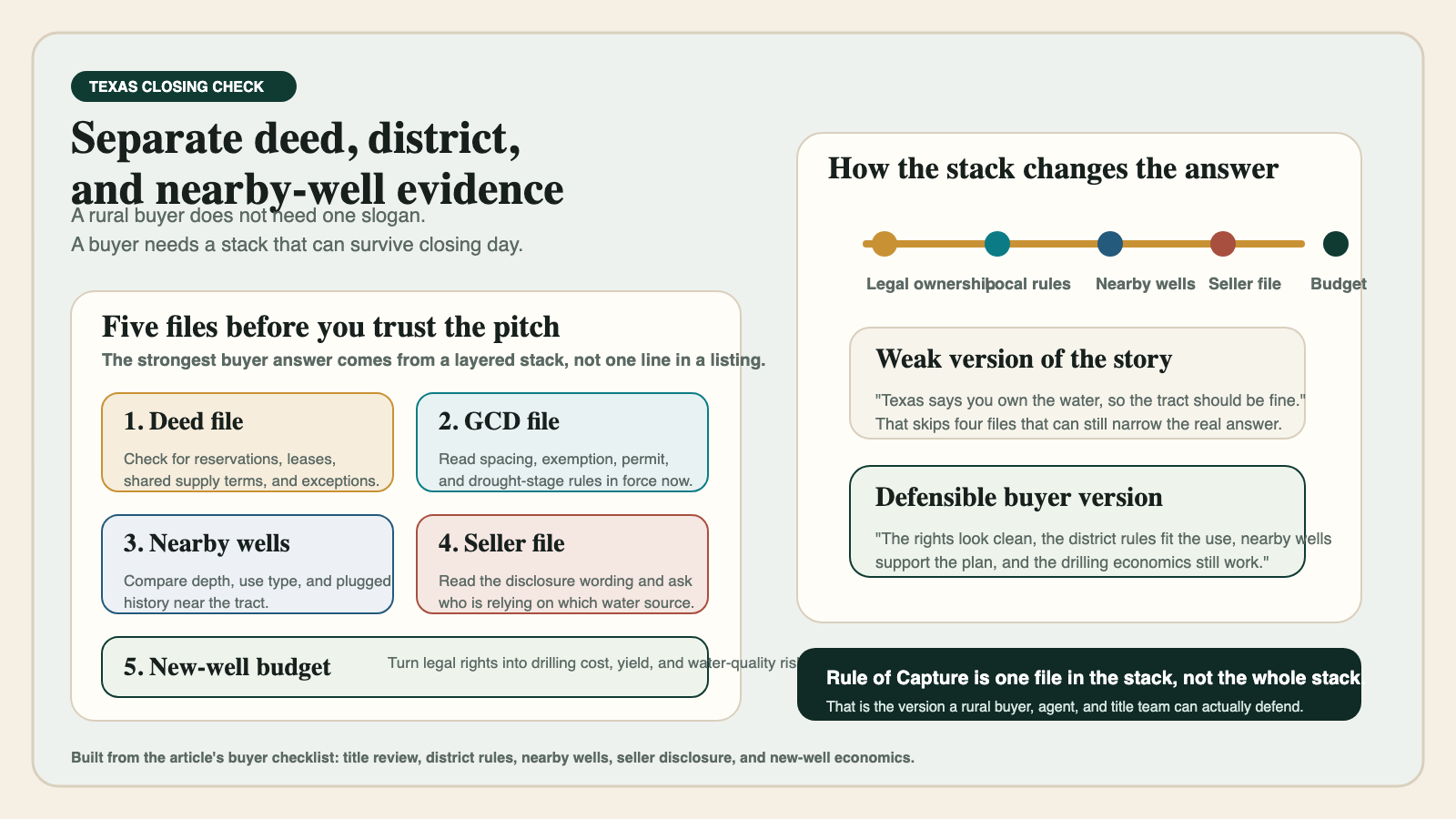
A buyer should not expect a blog article, seller comment, or even a basic public record hit to answer every water-rights question cleanly. The buyer should expect to ask title-focused questions: were groundwater rights ever severed, are there easements or off-tract supply arrangements, does an existing well benefit anyone beyond the tract, and does the deed history raise any water-rights exceptions that need review?
Why legal ownership still does not guarantee a good well
Even with clean title and no district surprises, the aquifer can still be the boss. A buyer can legally own groundwater rights and still face thin nearby well evidence, weaker water quality, deeper drilling than expected, low yield, or rising cost because the local pattern is simply harder than the brochure suggested.
This is where TurnKey Wells takes a practical stance instead of a political one. The point is not to rant about development, districts, or lawyers. The point is to separate legal ownership from hydrogeology. One is a rights question. The other is a performance and cost question. Smart rural buyers check both.
If the purchase depends on drilling or relying on a private well, a Pre-Drill Intelligence Report can help organize the tract’s district context, nearby wells, plugged-well history, and aquifer clues into one file before the expensive decisions begin.
A practical buyer checklist before you trust the phrase “you own the water”
- Verify district status first. Confirm whether the tract is inside a groundwater conservation district and read the domestic or exempt-well rules that actually apply there.
- Check nearby well evidence. Compare nearby domestic wells by depth, date, pump setting, use type, and plugging history rather than relying on countywide averages.
- Ask title-specific groundwater questions. Look for prior reservations, leases, sales, easements, or off-tract water arrangements that may affect groundwater rights.
- Do not confuse exempt with unrestricted. A domestic well may avoid one permit path while still being affected by district rules, spacing, or construction requirements.
- Treat seller language as a starting point, not proof. “Plenty of water” and “you own the water” should trigger review, not end it.
- Separate rights from hydrogeology. Clean ownership does not guarantee yield, water quality, or low drilling cost.
See nearby reported wells and plugged-well history before you rely on a rural listing.
Deeper reviewOrder a Pre-Drill Intelligence ReportOrganize groundwater district, nearby well, and aquifer risk for one property.
Bottom line for rural Texas buyers
Texas does not treat groundwater ownership as fake. But the buyer mistake is assuming that legal ownership settles the practical water question by itself. It does not. The tract may still carry district limits, title complications, neighboring pumping risk, or a hard drilling profile that changes the whole economics of the deal.
Before closing, move past slogans. Use the Water Intelligence hub for Texas-specific groundwater context, verify the district boundary, review nearby well records, read the disclosure file carefully, and treat groundwater rights as one part of a larger rural due-diligence stack.
Source notes
- Texas Water Code Chapter 36, checked July 24, 2026, for groundwater conservation district framework, ownership-in-place language, permit structure, spacing, production limits, and exemptions.
- Texas Water Development Board groundwater conservation district resources and related TWDB groundwater pages, checked July 24, 2026, for district-management context.
- Texas Real Estate Commission Seller’s Disclosure Notice page, checked July 24, 2026, for current disclosure-form context tied to Section 5.008 of the Texas Property Code.
- Houston & Texas Central Railway Co. v. East, Sipriano v. Great Spring Waters of America, Edwards Aquifer Authority v. Day, and secondary summary material on Coyote Lake Ranch v. City of Lubbock for the Texas rule-of-capture and groundwater-ownership backdrop.
- This article is a practical buyer brief, not legal advice, title advice, or a drilling guarantee. Property-specific title review, district rules, and well evidence still control the real answer.
Media, source, or interview requests: contact TurnKey Wells about Texas groundwater, private wells, aquifers, and water-use research.