Diode Ventures walked away from a proposed Henderson County data center near Cedar Creek Reservoir after weeks of local backlash. That does not make the water question go away. It shows what rural buyers should verify before one tract gets tied to a huge new user.
The Henderson County data center fight is over for now. The better lesson is not that the community won one round. It is that water due diligence has to happen before a rural tract gets wrapped in a big infrastructure story.
Texas Tribune reported on July 23 that Kansas-based Diode Ventures withdrew its proposed Henderson County data center after the company said it would not be able to comply with Gov. Greg Abbott’s development standards. That is the headline. The more useful property-owner question is what made the project feel risky so quickly.
Residents were not just reacting to the words data center. They were reacting to siting, transparency, utility capacity, and water-source pressure around Cedar Creek Reservoir. That combination is important because it can show up again in other East Texas counties, in other reservoir communities, and around rural tracts that are suddenly close to a very large proposed user.
The withdrawal does not prove every data center is a bad project. It proves that source-water math, utility capacity, public transparency, and local oversight have to be sorted out early. Rural buyers should treat that as a repeatable due-diligence lesson, not a one-off news fight.
What happened in Henderson County
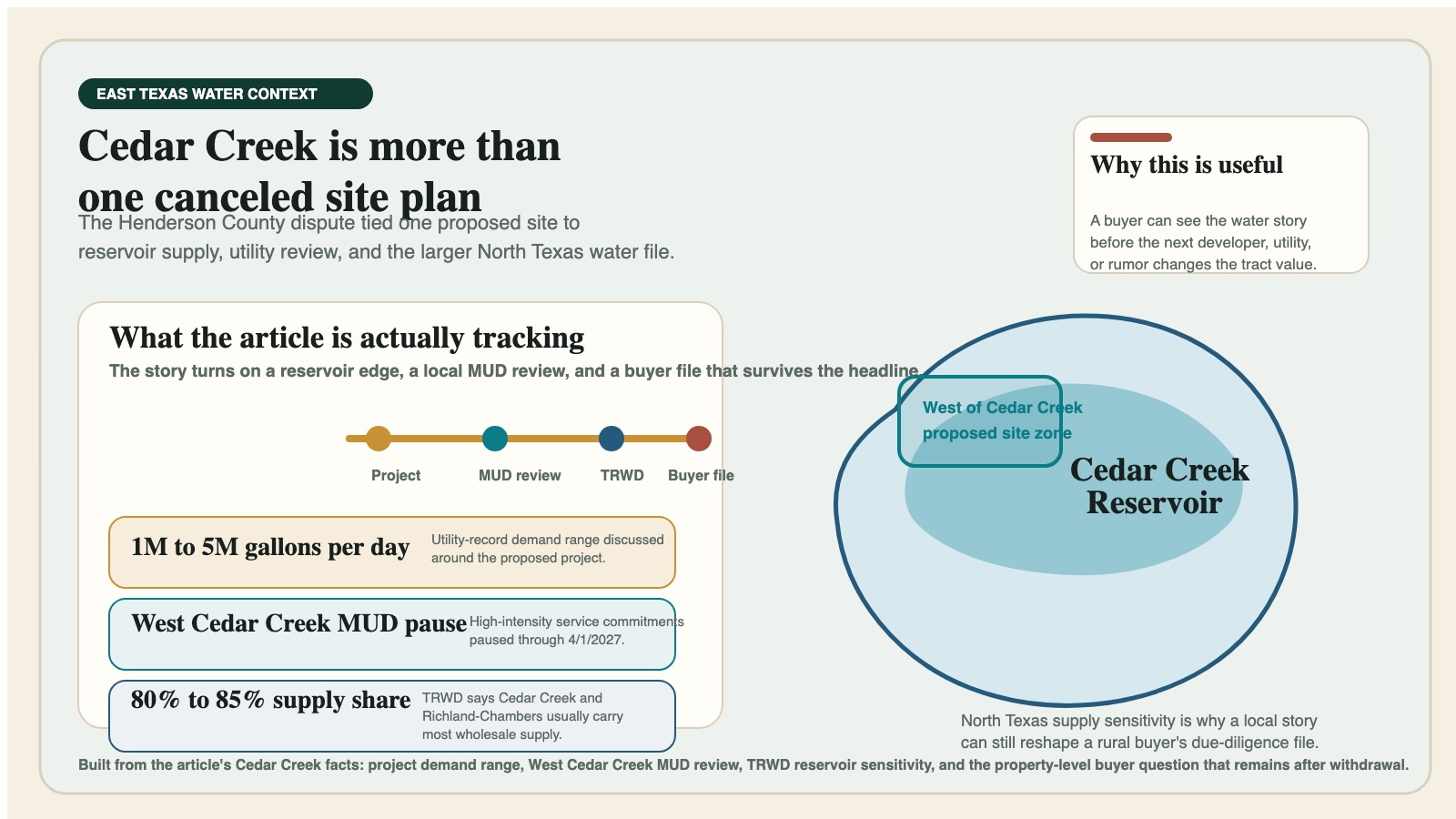
KERA’s July 2 reporting, republished from Fort Worth Report, said the proposed project would sit west of Cedar Creek Lake between Trinidad and Tool and could require between 1 million and 5 million gallons of water per day based on utility records and project communications. The same reporting said West Cedar Creek Municipal Utility District moved forward a temporary suspension on high-intensity water service commitments through April 1, 2027 so it could review water availability, projected demand, and wastewater-system impacts.
Texas Tribune’s follow-up on July 23 said the company then withdrew after Abbott’s tougher development standards and local backlash sharpened the pressure. Tribune also noted that residents were worried about the location itself because the project would sit inside a developed subdivision area near a lake already tied to North Texas drinking-water supply.
That sequence is important. The project did not fail on one abstract anti-growth slogan. It ran into a stack of practical questions: where would the water come from, could the local utility support it, what would nearby residents live next to, and what would drought years look like if the demand actually ramped up?
Current Signal
Why Cedar Creek is the wrong place to treat water as an afterthought
Cedar Creek Reservoir is not an isolated pond serving one subdivision. TRWD says Cedar Creek and Richland-Chambers usually supply 80 to 85 percent of the water it provides to primary wholesale customers in North Texas. That means reservoir politics in Henderson County can become a real planning question for people much farther west.
At the same time, TRWD’s updated July 27 public data-center page is useful because it draws a hard line between rumor and approved supply. TRWD says the developer and West Cedar Creek MUD have formally withdrawn their requests, the project is no longer proceeding, and TRWD has not entered into any new water-supply contracts specifically to serve data center projects. That is the kind of public clarification buyers should want to see whenever a large-user story starts circulating.
The deeper lesson is that a big project can sound half-real for months while key water facts are still unsettled. Buyers near a reservoir, proposed pipeline, or rural utility district should not assume that a quiet tract will stay quiet just because a first proposal dies. The land may still be for sale, the infrastructure idea may still be attractive to another developer, and the water question may come back with a different company name.
The local utility and groundwater layers are different problems
One easy mistake is to treat this story as only a lake-water issue. It is not. Reservoir supply, utility-delivery limits, groundwater-district coverage, and nearby private-well evidence are separate layers, and buyers need all of them.
The utility layer tells you whether a local provider can even move the requested water without major upgrades or new contracts. The reservoir layer tells you how politically and regionally sensitive that source may be. The groundwater layer tells you whether a developer, nearby owner, or future project could pivot into a different source story if surface-water routes get harder.
That is where Henderson County starts looking like more than one news cycle. A rural buyer near Cedar Creek should still ask what the nearby private-well file looks like, what the existing Henderson County well record context suggests, whether the tract sits inside a district or near changing regulatory boundaries, and how the Carrizo-Wilcox aquifer context changes the long-term picture.
What rural buyers should verify before they trust a withdrawal headline
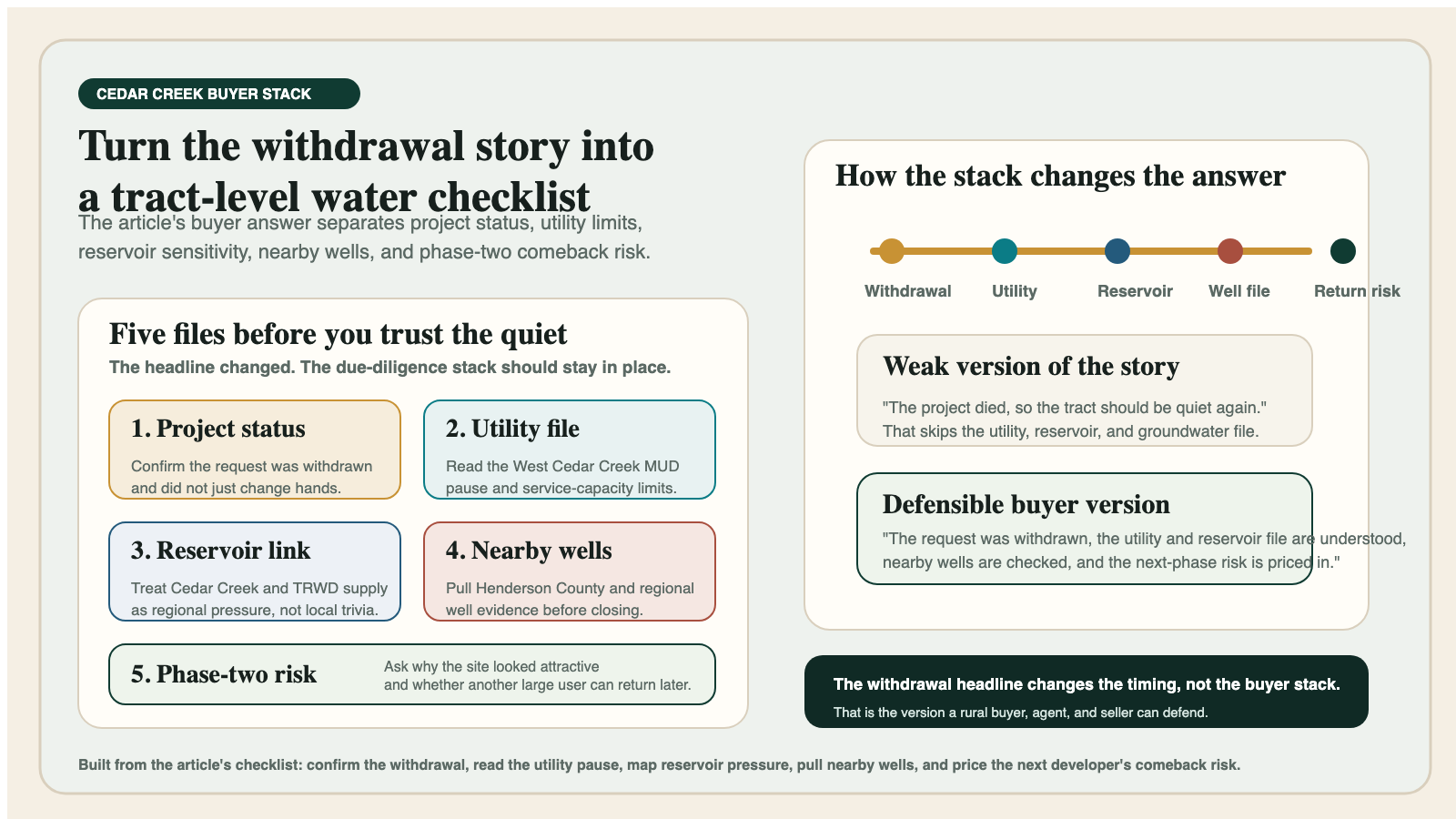
- Check whether the project truly died or just changed hands. A withdrawn request is not the same thing as a permanently quiet site.
- Separate the utility story from the groundwater story. A local water-service freeze does not answer whether future demand could reappear through another source path.
- Pull nearby well evidence early. A Free Well Check is more useful than county folklore when you need to know what nearby domestic, irrigation, or plugged wells actually show.
- Use the tract-level file, not just the county headline. A Pre-Drill Intelligence Report helps tie records, aquifer clues, and district context back to one address before a land decision gets expensive.
- Verify district and disclosure context. The Texas Groundwater District Lookup and the TREC Form 61-0 guide are better tools than rumor when the water question starts affecting value, financing, or closing leverage.
- Look for phase-two risk. Even if one proposal dies, ask what made the site attractive in the first place and whether another large user could come back with a cleaner pitch later.
See what nearby Texas well records say before a development rumor hardens into a pricing assumption.
Site reviewOrder a Pre-Drill Intelligence ReportOrganize tract-level records, aquifer clues, and district context before buying or drilling near a big water-use story.
What this means for buyers, sellers, and agents right now
If you are marketing land near Cedar Creek or another rural water-supply flashpoint, do not oversell silence. Buyers know the large-user story may come back. The cleaner move is to document what is actually known: current water source, nearby well evidence, district status, subdivision or utility context, and what the public agencies have said to date.
If you are buying, do not let a withdrawn proposal create false comfort. A tract near a contested water source can still carry future pressure, higher scrutiny, or a very different value conversation depending on who shows up next. That is where current public statements, local water records, and the buyer’s own due-diligence file carry more weight than a reassuring rumor.
For agents and landowners, this story also shows why statewide planning still counts. The 2027 State Water Plan demand-gap brief is useful because it reminds you how quickly project-level demand can outrun formal planning language. A local fight can arrive long before the statewide documents fully catch up.
Bottom line
Henderson County did not just produce an anti-data-center headline. It produced a clean case study in what water due diligence looks like when a very large user shows up near a sensitive source and a rural tract pattern.
The smart move for rural buyers is not to cheer the withdrawal and move on. It is to verify the real water stack before the next proposal appears: utility capacity, reservoir relevance, district rules, nearby well records, and what the site still represents to the market after one developer leaves.
Source notes
- Texas Tribune, July 23, 2026, on Diode Ventures withdrawing from the Henderson County proposal, the community backlash, the subdivision siting issue, and Gov. Abbott’s development-standards response.
- KERA / Fort Worth Report, July 2, 2026, on the proposed location, the 1 million to 5 million gallon daily water range, and West Cedar Creek MUD’s temporary suspension on high-intensity water service commitments.
- TRWD data center water request page, checked July 29, 2026, confirming the developer and West Cedar Creek MUD withdrew their requests and that no new data-center-specific TRWD water contract was approved.
- TRWD water supply page, checked July 29, 2026, for the statement that Cedar Creek and Richland-Chambers typically supply 80 to 85 percent of water provided to TRWD’s primary wholesale customers.
- Texas Water Development Board 2027 State Water Plan page, checked July 29, 2026, for the adoption date and the statewide planning backdrop referenced in this buyer-oriented water-pressure brief.
- This article is a practical rural property and water due-diligence brief, not legal advice, engineering advice, or a guarantee about future development activity near any tract.
Media, source, or interview requests: contact TurnKey Wells about Texas groundwater, private wells, aquifers, and water-use research.
Keep Reading
Need help reviewing the water risk around a rural property?
Ask TurnKey Wells to review the records, planning pressure, and next steps.
Tell us what property you are evaluating, whether the concern is a nearby large user, a private well question, or a closing deadline, and what public signals you have already seen. TurnKey Wells can help review the issue, organize the records, and connect you with a licensed water well professional in your area when field work is needed.
TurnKey Wells helps organize records, next steps, and qualified local referrals. TurnKey Wells is not the drilling or repair contractor.