Texas private well planning
The Carrizo-Wilcox Aquifer in Texas
A property owner guide to well depth, yield, water quality, counties served, groundwater district rules, and what to check before drilling or buying land with a well.
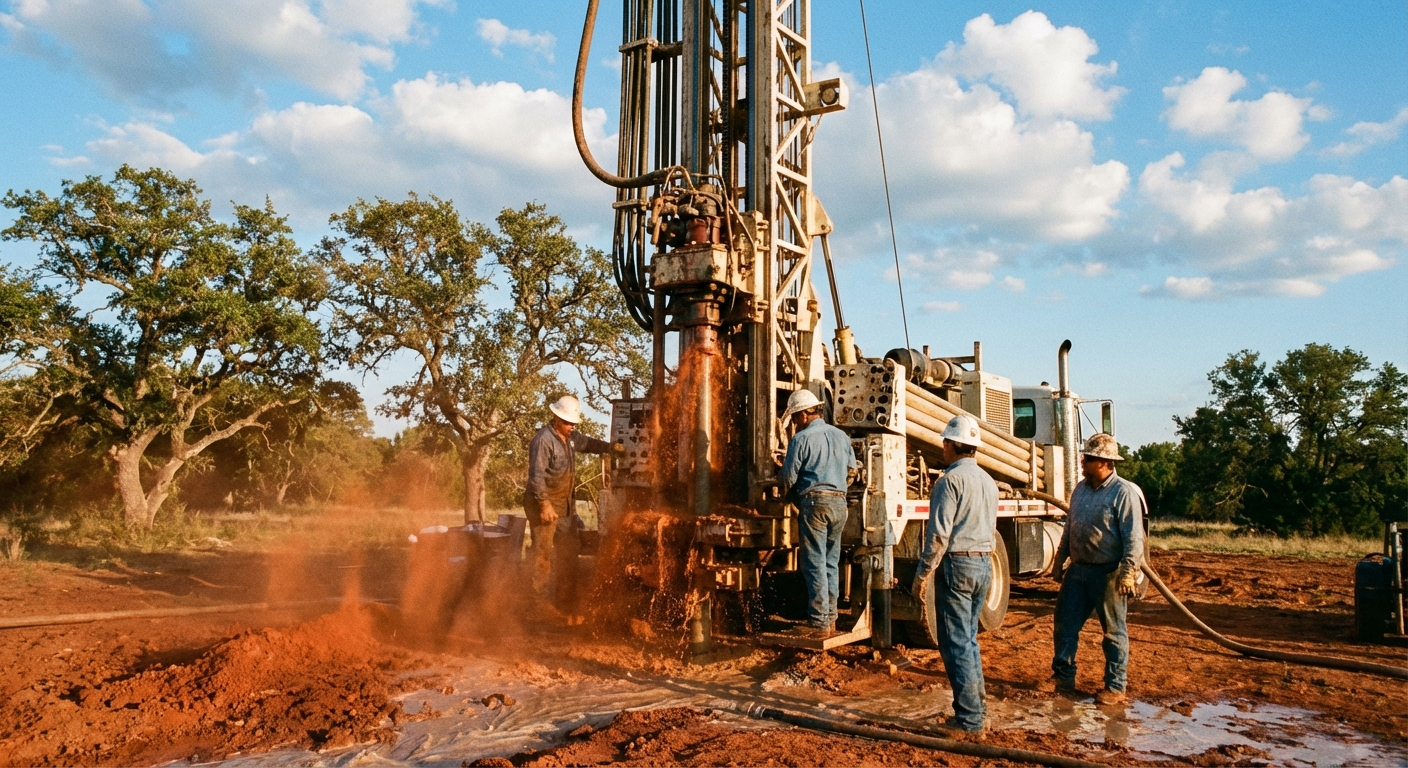
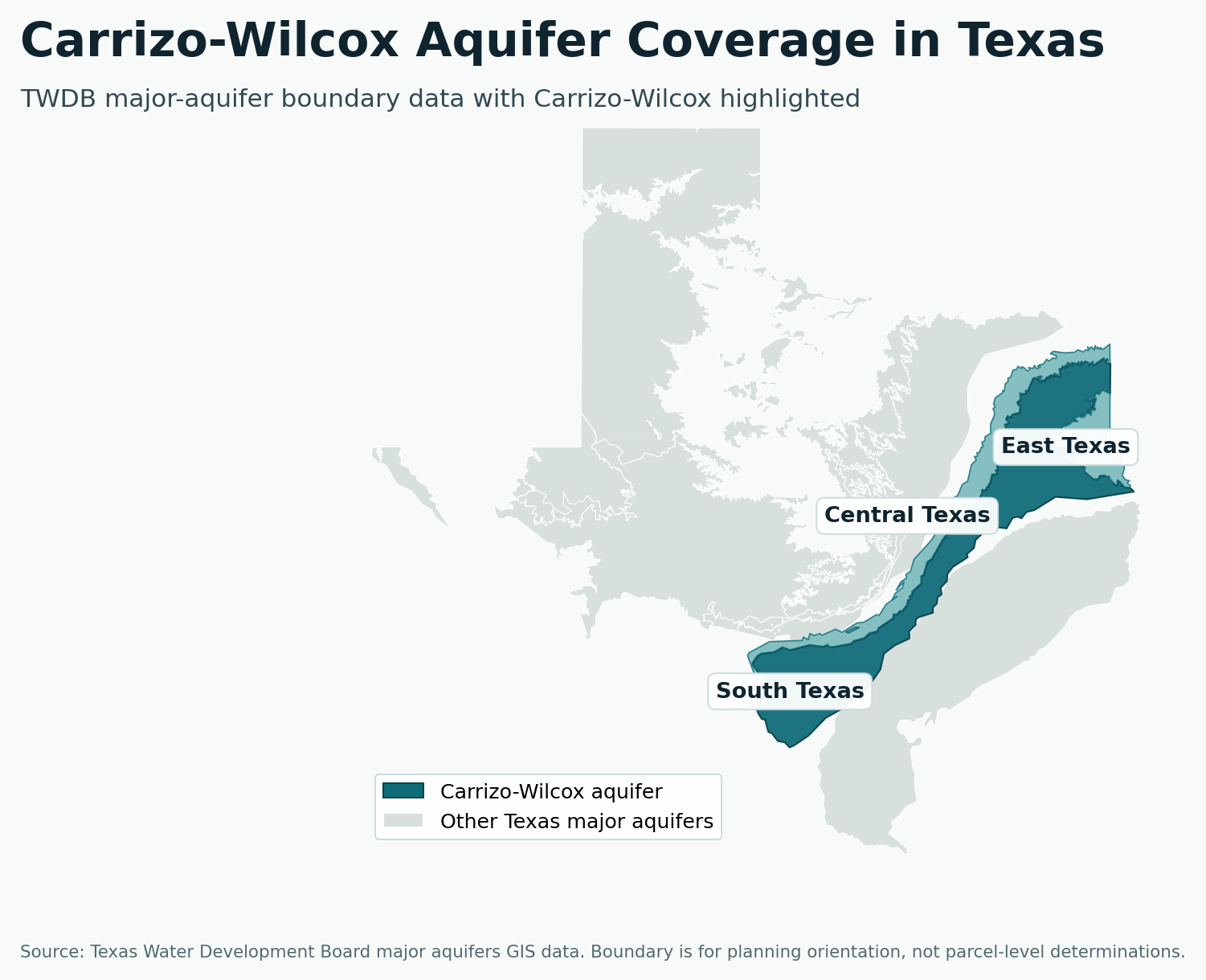
The Carrizo-Wilcox Aquifer is one of the most productive and geographically expansive groundwater systems in Texas. It runs in a broad arc from the Rio Grande near Laredo northeast through Central Texas, across the Pineywoods and into East Texas, touching dozens of counties where rural property owners, farmers, ranchers, and small-town water systems depend on it for their water supply. For anyone buying acreage, planning a well, selling rural land, or evaluating a property with an existing well in this part of the state, understanding the Carrizo-Wilcox is not optional. It determines drilling depth, expected yield, water treatment decisions, and which groundwater district rules apply before the first bit turns.
This guide is written for property owners, land buyers, real estate agents, and anyone involved in a transaction where a private well is part of the picture. It covers geology, depth ranges, water quality, counties, groundwater district rules, permitting requirements, and how to use well records to make better decisions before committing money or expectations to a well project. It is a planning resource, not a substitute for a licensed driller, a groundwater professional, or a local Groundwater Conservation District.
Quick Facts About the Carrizo-Wilcox Aquifer
| Planning Item | Practical Property Owner Meaning |
|---|---|
| Aquifer type | Multi-layer sand and sandstone aquifer system with interbedded clays and confining units |
| Main Texas region | Broad arc from Webb and Maverick counties in South Texas northeast through Central and East Texas to the Louisiana border |
| Common well use | Domestic wells, municipal supply, irrigation, livestock, and industrial supply across dozens of counties |
| Typical domestic depth range | Highly variable by county and position in the aquifer, often 200 to 600 feet in Central Texas counties, deeper in South Texas and down-dip East Texas zones |
| Typical domestic yield range | Generally productive, domestic wells often yield 5 to 50 gallons per minute, with irrigation wells sometimes reaching several hundred gallons per minute |
| Main planning variables | Target sand unit (Carrizo vs. Wilcox), depth to water, casing depth, nearby well records, water quality, and GCD rules for the specific county |
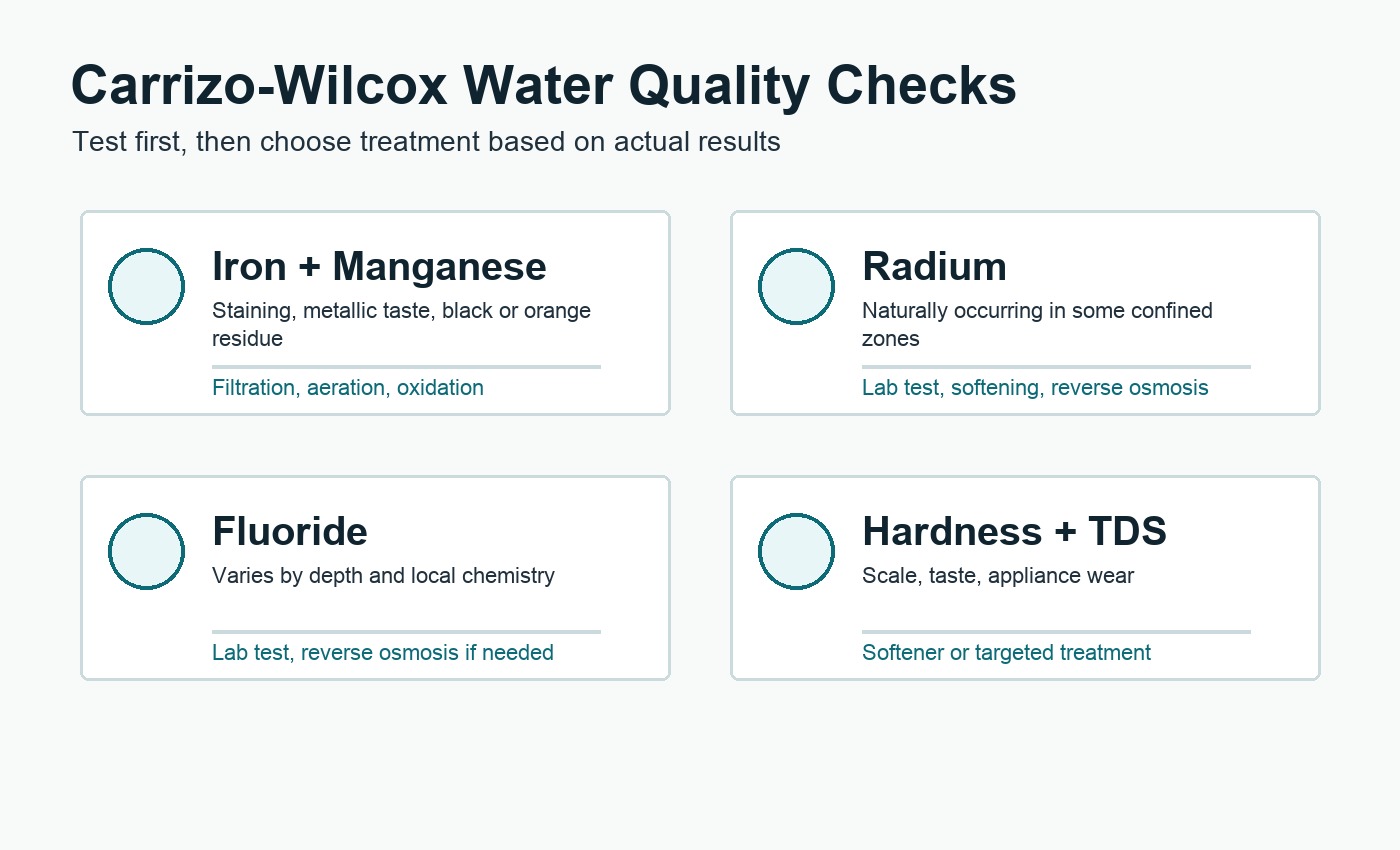
| Common water quality concerns | Iron, manganese, naturally occurring radium, elevated fluoride in some areas, hardness, and total dissolved solids that vary by zone and depth |
| Regulatory check required | Most counties in the aquifer footprint fall under one or more Groundwater Conservation Districts, confirm before drilling |
The Carrizo-Wilcox is designated as a major aquifer by the Texas Water Development Board, which means it is tracked, studied, and regulated with more rigor than many minor aquifers across the state. That designation reflects its size and importance: it is one of the largest freshwater aquifers in the southeastern United States, and Texas draws hundreds of millions of gallons from it each year for municipal water systems alone. For a private property owner, that context matters because it signals that the groundwater rules, permit requirements, and conservation district authority in this region tend to be more developed and more actively enforced than in some rural areas with less-studied aquifer systems.
Geology: What the Carrizo-Wilcox Actually Is
The name Carrizo-Wilcox combines two geologic formations that share the same general aquifer zone. The Wilcox Group is the older and deeper unit, consisting of sands, clays, and lignite-bearing sediments deposited during the early Eocene epoch, roughly 56 to 40 million years ago, when the Gulf of Mexico shoreline stood much farther inland than it does today. The Carrizo Sand is a distinct formation within or closely associated with the Wilcox sequence, typically more consistently sandy and more reliably productive than some Wilcox intervals. Together, they are treated as a single aquifer system by the TWDB because the water moves through them as a connected system in most areas.
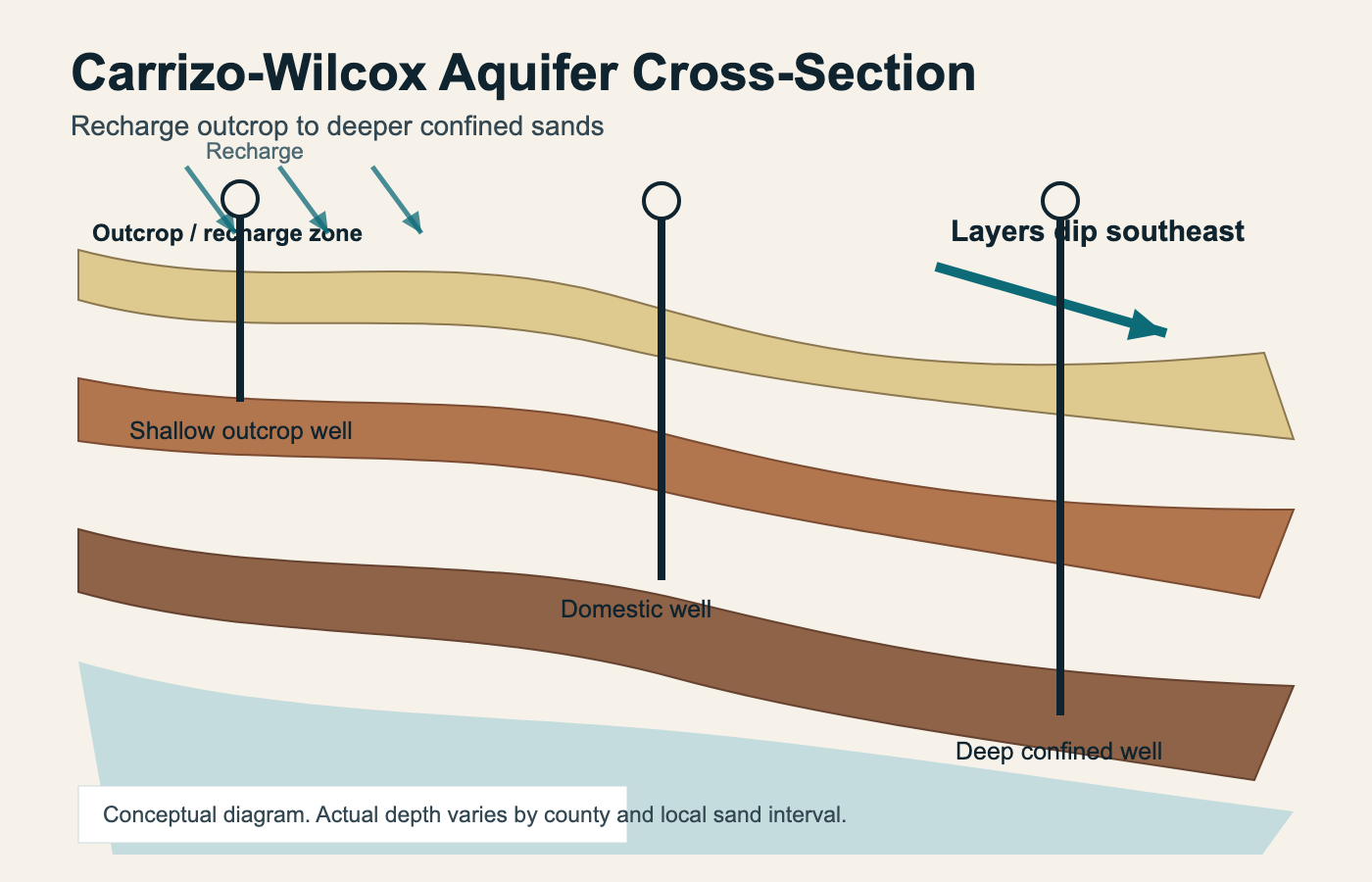
The aquifer sediments were deposited as river deltas, coastal plains, and near-shore marine environments built out the ancestral Gulf Coast. As sea level fell and sediments accumulated, the layers were buried, tilted gently toward the Gulf, and eventually covered by younger formations. Today, the Carrizo-Wilcox crops out at the surface in a narrow band, the outcrop zone, running from the Laredo area northeast through roughly the center of Central Texas, then curving east toward the Louisiana border. This outcrop zone is where rainwater recharges the aquifer by soaking into exposed sands. Down-dip to the southeast, the aquifer is buried progressively deeper under younger sediments and becomes confined, meaning it is under pressure and does not receive direct surface recharge.
This structure has two important practical consequences for property owners. First, depth to water increases significantly as you move from the outcrop zone southeast toward the Gulf. A well in the recharge zone near the surface exposure might reach water at 150 to 300 feet. A well deep in the confined zone in a down-dip East Texas county might need to reach 600, 800, or 1,000 feet or more to hit the same aquifer. Second, water quality can differ substantially between the unconfined, recharge-zone portion of the aquifer and the confined down-dip portion, where longer residence time and different geochemical conditions can produce elevated iron, manganese, radium, fluoride, or total dissolved solids.
Within the aquifer system, individual sand bodies vary in thickness, continuity, and productivity. A driller targeting the Carrizo-Wilcox in Robertson County may hit a productive Carrizo sand at 350 feet. In an adjacent county or even a few miles away, that same sand might be thinner, absent, or separated from the water table by a clay layer that requires drilling deeper. This variability is why nearby well records and local driller experience matter so much. Published aquifer summaries are useful for orientation, but the well logs of your actual neighbors are more useful for predicting what will happen on your specific tract.
The History of the Carrizo-Wilcox Aquifer in Texas
The Carrizo-Wilcox Aquifer has shaped rural Texas for generations because it sits under a long sweep of counties where farms, ranches, small towns, and acreage properties often depend on groundwater instead of city water. Long before modern well databases existed, springs, shallow wells, and hand-dug supplies helped settlers understand where the sandier formations could hold usable water.
As drilling equipment improved in the 20th century, the Carrizo and Wilcox sands became a major source for domestic wells, livestock water, municipal supplies, and irrigation in parts of East Texas, Central Texas, and South Texas. The aquifer became especially important in places where surface water was unreliable, where rural subdivisions moved beyond utility lines, or where ranch land needed independent water.
The modern planning challenge is that the Carrizo-Wilcox is not one simple layer. It is a stacked system of sands, sandstones, silts, clays, and confining beds. Older records may say Carrizo, Wilcox, or both, while nearby wells can still vary sharply in depth, yield, and water quality. That is why a buyer should not treat a regional aquifer name as a guarantee.
For today’s property owner, the history matters because the aquifer has been used heavily in some corridors and lightly in others. A strong planning review should compare nearby well records, completion depths, reported yields, groundwater district rules, and local water-quality patterns before a buyer assumes a new well will behave like an old county average.
Which Counties Does the Carrizo-Wilcox Serve?
The Carrizo-Wilcox Aquifer stretches through a long list of Texas counties. For practical planning purposes, the counties where it serves as the primary or dominant source for private domestic and irrigation wells, and where TurnkeyWells well records provide the most context, include the following regions.
Central Texas and Brazos Valley Transition Zone
This region includes counties like Robertson, Leon, Limestone, Falls, Milam, and McLennan, where the Carrizo-Wilcox supplies domestic wells, small ranches, and rural residential tracts in areas that do not have access to municipal water service. In Robertson County, well records show average domestic depths around 397 feet with a wide range from shallow alluvial wells near the Brazos River to deeper Carrizo sands farther from the river corridor. In Leon County, average domestic depth runs around 415 feet, with Queen City and Sparta sand intervals sometimes tapped in addition to the Carrizo.
In Limestone County, the Carrizo-Wilcox serves much of the county’s rural water needs, with average domestic depths around 214 feet in the portion of the county where the shallower intervals are accessible. Falls County sits on the Brazos River corridor, where alluvial wells near the river tend to be shallow, but upland Carrizo-Wilcox wells are deeper and more variable. Milam County averages around 225 feet for domestic wells, with a mix of Woodbine and Carrizo sands in some areas depending on structural position.
East-Central Texas, Freestone, Anderson, Navarro, Van Zandt
Moving east and southeast, the Carrizo-Wilcox remains an important source for rural properties in counties like Freestone, Anderson, Navarro, and Van Zandt. In Freestone County, the TWDB records include 2,436 wells with a median domestic depth of about 260 feet. A significant portion of the industrial and rig-supply well record in Freestone relates to energy operations and can skew county-wide depth averages, property buyers should look at domestic well records specifically when estimating costs for a private home well.
Anderson County, which includes the Palestine and Lake Palestine area, shows median domestic depths around 260 feet as well, with the Trinity aquifer also present in parts of the county. The overlapping aquifer geography in this area means a property’s primary water source may differ depending on exact location. Getting a pre-drill record check for the specific parcel is more reliable than relying on county-level estimates alone.
Deeper East Texas
In East Texas counties, including Houston, Trinity, Angelina, Nacogdoches, Sabine, San Augustine, and others, the Carrizo-Wilcox is buried progressively deeper as the formations dip toward the Gulf. Domestic depths in this region can range from 300 to 800 feet or more. Municipal water systems in some East Texas towns draw from the Carrizo-Wilcox at significant depths through high-capacity public supply wells. Private domestic wells typically target shallower permeable intervals when available, but in confined portions of the aquifer, well construction is more complex and expensive than in shallower Central Texas counties.
South Texas
The southern limb of the Carrizo-Wilcox extends through Webb, Maverick, Dimmit, Zavala, Frio, McMullen, La Salle, and surrounding counties. Here the aquifer supports significant irrigation activity as well as municipal and domestic supply for a region with limited surface water. Well depths in South Texas tend to be moderate to deep, and water quality management, particularly for elevated naturally occurring radium and dissolved solids, is an active issue that landowners and municipal systems both address through treatment or source blending.
Well Depth and Yield: What the Records Show
Depth to water and expected yield are the two questions property owners ask most often about any aquifer, and the Carrizo-Wilcox does not have a single answer for either. Depth varies by county, by position in the aquifer (outcrop vs. confined), by which sand interval is targeted, and by local structural conditions. Yield varies with the sand thickness, permeability, and how much water the formation delivers under the specific conditions at a given location.
In the Central Texas portion of the aquifer, where TurnkeyWells has the densest well record coverage, domestic wells commonly range from about 150 feet to 600 feet. The Carrizo Sand itself, when a driller hits a good interval, is capable of producing substantial flows for domestic purposes, often 5 to 30 gallons per minute for a properly constructed residential well. Irrigation wells drilled into thick Carrizo intervals in good locations have produced several hundred gallons per minute, which is why irrigated agriculture remains economically viable in parts of Central and South Texas despite limited surface water.
For a property owner planning a domestic well, the practical question is not the maximum the aquifer can produce, but what a well at the specific location is likely to produce for household purposes. A domestic supply of 3 to 10 gallons per minute is often sufficient for a single-family home, especially when paired with a pressure tank and storage system. The driller’s experience with wells in the immediate area is the best guide to what is realistic, but nearby well records provide an independent check on both depth and reported yield.
What Affects Depth on a Specific Property
- Position along the aquifer dip: Properties closer to the outcrop zone tend to encounter water at shallower depths. Properties farther down-dip to the southeast reach water deeper.
- Local sand continuity: Some locations sit above a thick, continuous Carrizo sand. Others sit above a pinched or thin interval, requiring drilling deeper to find adequate production.
- Land surface elevation: Upland positions away from river valleys can require deeper drilling than bottomland positions near surface water.
- Geologic structure: Faults, flexures, and local structural highs or lows can shift the depth at which productive sands are encountered.
- Prior drilling in the area: The best predictor of depth at a specific property is what wells drilled within one to three miles have already reported. A driller who has worked in the area and has firsthand experience with the local formation is worth more than any county average.
Water Quality in the Carrizo-Wilcox
Water quality in the Carrizo-Wilcox aquifer varies across the system, and property owners who plan to use a Carrizo-Wilcox well for drinking water should treat a water quality test as a standard part of the process rather than an optional add-on.
Iron and Manganese
Elevated iron and manganese are the most common aesthetic issues in Carrizo-Wilcox wells. Both are naturally occurring metals that dissolve from sediments into groundwater under reducing (low-oxygen) conditions typical of confined aquifer zones. At elevated concentrations, iron causes reddish-orange staining on fixtures, laundry, and irrigation equipment. Manganese causes black or brown staining and at high concentrations has raised health concerns in public health research on long-term exposure. Neither is uncommon in East Texas and deeper Central Texas Carrizo-Wilcox wells. Water treatment, typically iron filtration, aeration, or chemical precipitation followed by filtration, is effective for both and is routinely installed on Carrizo-Wilcox wells in affected areas.
Radium and Radioactivity
Naturally occurring radium, specifically radium-226 and radium-228, has been detected at elevated levels in some portions of the Carrizo-Wilcox aquifer, particularly in the confined, down-dip sections. The EPA maximum contaminant level for combined radium is 5 picocuries per liter. Public water systems drawing from the Carrizo-Wilcox in affected areas are required to test and treat. Private well owners are not subject to federal drinking water standards but can face the same exposure without testing. Radium testing is a recommended part of any new Carrizo-Wilcox well commissioning in South Texas and deeper East Texas portions of the system.
Fluoride
Fluoride occurs naturally in groundwater throughout Texas, and some Carrizo-Wilcox wells have produced water with fluoride concentrations above the EPA secondary maximum contaminant level of 2 milligrams per liter (the primary MCL for health is 4 mg/L). At very high concentrations, fluoride can cause dental or skeletal fluorosis with long-term exposure. At moderate concentrations between 1 and 2 mg/L, most public health guidance considers it not harmful for adults, though infant formula prepared with high-fluoride water has been a subject of public health guidance. Testing and, if necessary, reverse osmosis or other treatment addresses this issue.
Total Dissolved Solids and Hardness
Total dissolved solids (TDS) and water hardness vary considerably across the Carrizo-Wilcox. Some shallower, upgradient wells produce relatively soft, low-TDS water. Deeper, confined sections can have higher TDS reflecting longer residence time and more mineral dissolution. Hard water causes scale in water heaters, pipes, and appliances and affects the feel of water. Water softeners are a practical solution in hard-water areas. TDS at moderate levels is largely an aesthetic concern, but very high TDS can affect the taste of drinking water and the suitability of the supply for certain agricultural uses.
Groundwater Conservation Districts: Permitting and Your Property
Most of the land above the Carrizo-Wilcox Aquifer falls within the jurisdiction of one or more Groundwater Conservation Districts (GCDs). These are state-authorized local regulatory bodies with the authority to require drilling permits, set spacing rules, cap production volumes, and require well registration. They vary significantly in how active they are, what permit requirements apply to domestic wells versus irrigation or commercial wells, and what fees or notice requirements exist.
A central feature of Texas groundwater law is that GCDs operate under the “rule of capture” as modified by the Legislature and the courts. Property owners have the right to produce groundwater beneath their land, but GCDs can place reasonable limits on that production in the interest of aquifer conservation and protecting neighboring users. In practice, many GCDs exempt small domestic wells from full permitting while still requiring basic registration. Others require permits for all wells regardless of size.
Key GCDs Covering Carrizo-Wilcox Counties
- Brazos Valley Groundwater Conservation District: Covers Falls, Robertson, and Milam counties. Regulates well drilling and production in the Carrizo-Wilcox portion of these counties.
- Post Oak Savannah Groundwater Conservation District: Covers Milam and Burleson counties in the western transition zone of the Carrizo-Wilcox.
- Pineywoods Groundwater Conservation District: Covers Anderson, Cherokee, and Henderson counties in the East-Central Texas Carrizo-Wilcox zone.
- Upper Guadalupe River Authority and associated GCDs: Relevant for properties in Central Texas counties in the transition zone between the Carrizo-Wilcox and other aquifers.
- Evergreen Underground Water Conservation District: Covers Atascosa, McMullen, Frio, La Salle, and other South Texas counties in the Carrizo-Wilcox footprint.
- Wintergarden Groundwater Conservation District: Covers Val Verde, Kinney, Edwards, and surrounding counties in the southwestern Carrizo-Wilcox and related systems.
This is not a complete list. New GCDs are occasionally created by the Legislature, and district boundaries have been adjusted over time. Before drilling on any property in the Carrizo-Wilcox region, confirm which GCD has jurisdiction and what the current permit requirements are. TurnkeyWells offers a free GCD lookup tool for Texas properties, you can use it to confirm your district in seconds.
Look Up Your Groundwater Conservation District
Before drilling a Carrizo-Wilcox well, confirm which GCD has jurisdiction over your property and what permit requirements apply. The lookup is free and takes a few seconds.
TDLR Licensing: Who Can Drill
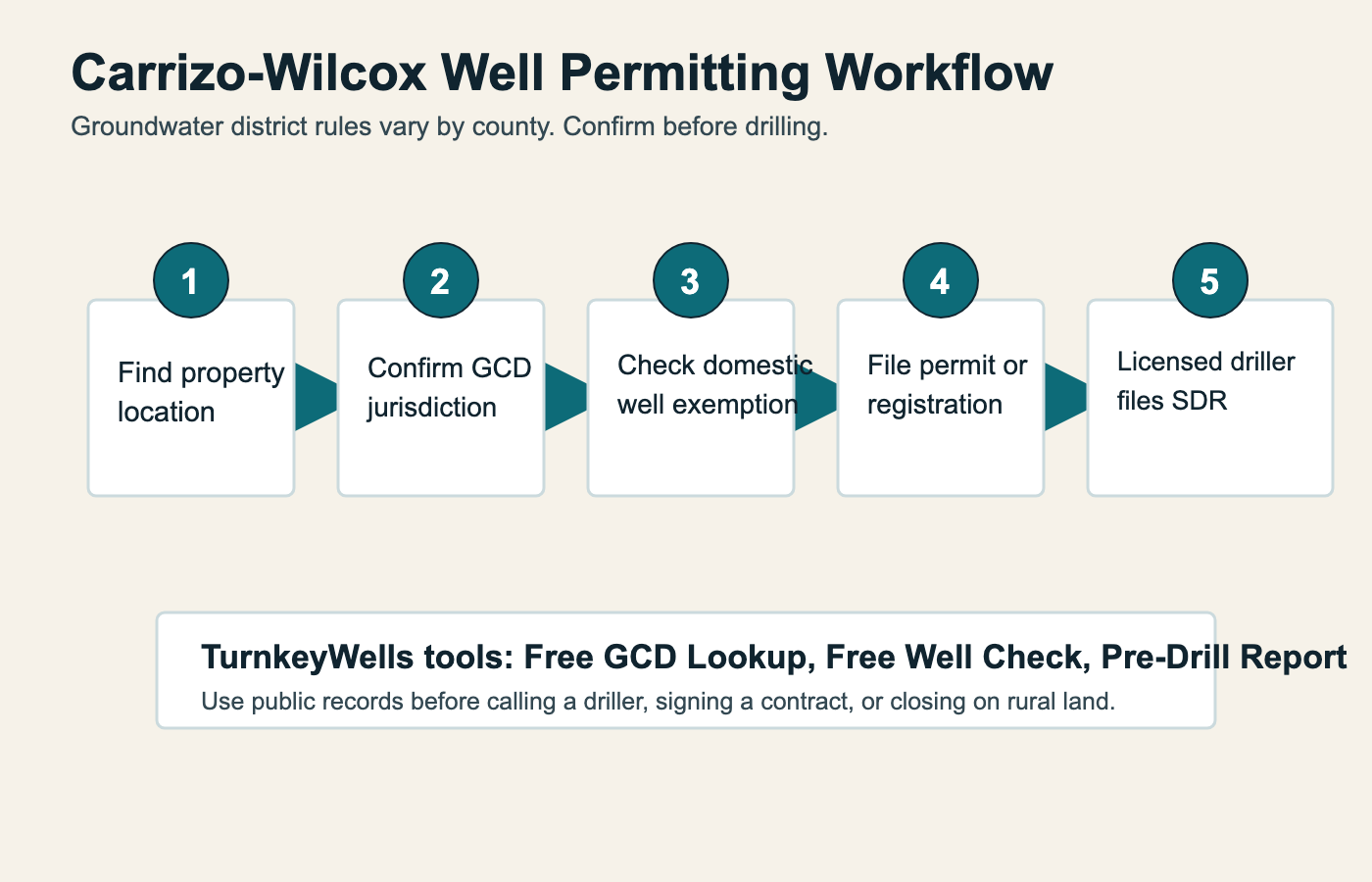
In addition to GCD rules, all water well drilling in Texas must be performed by a licensed water well driller under the Texas Department of Licensing and Regulation (TDLR). The driller must hold a current license and is required to file a completed well report, the Submitted Driller Report or SDR, with the Texas Water Development Board within 30 days of completing the well. This is the primary mechanism by which the state’s well registry is built and maintained. When a property owner pulls a permit and a driller completes the well, the SDR becomes a permanent public record that future buyers, title companies, or property owners can access to verify the well’s existence, depth, yield, and other characteristics.
The requirement to use a licensed driller and file a completion report applies to new wells, replacement wells, and wells that are deepened or otherwise substantially altered. Property owners who discover an old, unlicensed well on a property they are purchasing should be aware that the well may not appear in the TWDB registry and that bringing it into compliance, confirming its depth and condition, or properly plugging it may be necessary steps depending on the circumstances.
Buying Land With a Carrizo-Wilcox Well: What to Check
A property with an existing well in the Carrizo-Wilcox region can be a significant practical advantage for a buyer, no drilling cost, no waiting, immediate access to water infrastructure. But an existing well carries its own set of questions that should be answered before closing.
Is the Well in the TWDB Registry?
The first check is whether the well appears in the Texas Water Development Board’s Submitted Driller Reports database. If a well was drilled after roughly 1985 to 1990, there is a reasonable chance it has an SDR on file. Older wells, wells drilled informally, and wells that predate the modern reporting system may have no public record at all. A well with no public record still exists, but its depth, casing condition, water quality, and legal status cannot be verified from public data alone, that requires a physical well inspection and potentially a pump test.
TurnkeyWells’s Free Well Check searches registered well records for a property address. If a well shows up in the search, you can see the basic registered data. If no well appears, it may mean there is no well on the property, or it may mean the well predates the registry or was never properly reported.
Is the Well Registered to the Current Owner?
Well records include owner information at the time of drilling. In older records, the registered owner may be a prior owner, a developer, an entity that no longer exists, or in some cases a neighbor whose well was recorded against a nearby parcel. Registration discrepancies do not necessarily prevent a sale or mean the well is legally problematic, but they can create questions during title review and may require GCD notification or registration update when ownership transfers. Some GCDs require the new owner to notifythe district of the transfer as a condition of continued registration. A pre-purchase ownership check is a smart step.
Is the Well Physically Sound?
A well’s presence in the registry tells you it was drilled and reported. It does not tell you the current physical condition of the casing, the pump, the wellhead seal, or whether the water quality today matches what was reported at the time of drilling. An older Carrizo-Wilcox well may have corroded steel casing, a pump that is approaching end of life, or a wellhead that does not meet current sanitary standards. A physical well inspection by a licensed professional, separate from the driller who might bid the replacement job, is the most reliable way to assess condition before assuming the existing infrastructure is serviceable.
What Is the Current Water Quality?
Water quality at a Carrizo-Wilcox well can change over time. Iron and manganese levels can shift with changes in water table, seasonal recharge patterns, or nearby pumping activity. A well that tested clean in 1998 may have different water chemistry today. A basic water quality test at the time of sale, covering at minimum the main aesthetic parameters (iron, manganese, hardness, TDS, pH) plus the health parameters relevant to Carrizo-Wilcox wells (coliform bacteria, nitrates, fluoride, and in applicable areas radium), is reasonable due diligence for any property buyer relying on that well for drinking water.
Drilling a New Carrizo-Wilcox Well: The Pre-Drill Process
If you are buying land without an existing well, or planning to drill an additional well on a property you already own, the pre-drill process in Carrizo-Wilcox territory involves several steps that together determine the project scope and cost. Skipping any of these steps does not eliminate the risk, it only transfers it to the point where you are already committed financially.
Step 1: Confirm GCD Jurisdiction and Permit Requirements
Before calling a driller, find out which GCD governs your property and what permit or registration requirements apply. Some GCDs have straightforward domestic well exemptions that require only a basic registration form and a nominal fee. Others require a formal permit application with acreage verification, spacing compliance, and an approval process that can take several weeks. Starting the permit process early, before you are under time pressure from a construction schedule or a closing deadline, is standard practice for experienced property buyers in Carrizo-Wilcox territory.
Step 2: Pull Nearby Well Records
The TWDB Submitted Driller Reports database is the primary public source for well records in Texas. Searching for wells within one to three miles of your property gives you a real-world sample of what drillers have found at depth in the area: which sand intervals were targeted, how deep they drilled, what yield was reported, and whether any problems were documented. A concentration of wells at a particular depth range in your area is a strong indicator of where the productive sand is. A wide scatter of depths suggests variable geology that requires site-specific evaluation.
TurnkeyWells has assembled these records into a searchable tool. The Free Well Check returns registered wells near any Texas property address and serves as a quick starting point for understanding the local well record landscape.
Step 3: Get a Pre-Drill Intelligence Report
Beyond the basic well list, a structured pre-drill analysis organizes the nearby record data into a format that supports actual decision-making: expected depth range, local driller experience, aquifer identification, GCD confirmation, and a summary of the relevant risk factors for the specific location. This is what the TurnkeyWells Pre-Drill Intelligence Report provides, a data-backed overview of the well landscape around a specific Texas property address, built from the same TWDB dataset and local GCD records that a thorough property buyer would want before committing to a well project.
Step 4: Select a Licensed Driller
Texas requires that all water well drilling be performed by a TDLR-licensed driller. Licensing verifies that the driller has met training and testing requirements under state law. Beyond licensing, practical experience in the specific Carrizo-Wilcox county or area matters: a driller who has completed dozens of wells in the local formation knows where the sand is thick, where it pinches out, what casing depths are typically needed, and what yield ranges are realistic for the location. References from recent jobs in the county, confirmation that the driller will file the SDR with TWDB, and clarity on the scope of work, including what happens if the first target zone does not produce sufficient yield, are reasonable items to address before signing a contract.
Step 5: Plan for Water Treatment
Before spending money on a water treatment system, get a water quality test from the completed well. Treatment systems should be selected based on what the test actually shows, not on what is common in the area. A good treatment system for iron and manganese may not be appropriate for a well that turns out to have radium or fluoride as the primary concern. Testing first and designing treatment based on results is more cost-effective than installing a generic treatment package and hoping it addresses the actual issues.
Selling Land With a Carrizo-Wilcox Well: TREC Form 61-0 and Disclosure
Texas sellers of property with a water well are now required to complete TREC Form 61-0, the Water Notice: Seller’s Disclosure about Groundwater and Surface Water Rights, effective May 4, 2026. This form requires the seller to disclose information about groundwater and surface water rights, registered wells, GCD jurisdiction, and related matters. For a property with a Carrizo-Wilcox well, the form requires confirming which GCD governs the property, whether the well is registered, and whether there are active surface water rights or ponds associated with the property.
Sellers who are not familiar with their GCD, do not have the well registration information handy, or have questions about what the form is actually asking can use TurnkeyWells tools to gather the relevant information. The Free GCD Lookup identifies the applicable groundwater district for any Texas address. The Free Well Check identifies registered wells at or near the property address in the TWDB database. These are the same data sources a title company or buyer’s agent would use to verify the seller’s disclosures, so gathering them upfront reduces the chance of a disclosure dispute at closing.
The Carrizo-Wilcox in the Broader Texas Groundwater Picture
The Carrizo-Wilcox Aquifer is one of nine major aquifers designated by the Texas Water Development Board. It sits geographically between the Gulf Coast Aquifer to the south and southeast and the Trinity Aquifer system to the north and west. In much of Central Texas, the Trinity serves North Texas counties while the Carrizo-Wilcox serves counties farther south and east. In some transition counties, both aquifer systems are present at different depths, and a driller may target whichever zone is more productive or shallower based on local conditions.
Understanding which aquifer serves a property is relevant for several reasons. Different aquifers have different depth ranges, different water quality profiles, different GCD jurisdictions, and different long-term sustainability outlooks. The Carrizo-Wilcox has been subject to long-term monitoring by the TWDB, and in some areas, particularly in South Texas where irrigation demand is high, water levels have declined over decades of intensive use. GCDs in those areas have implemented managed depletion limits and production permits designed to extend the usable life of the aquifer. Property owners in high-demand areas should be aware that future production limits or permit requirements could affect how much water they can legally produce from a new well.
For the Central and East Texas portions of the Carrizo-Wilcox where TurnkeyWells county pages are currently concentrated, the aquifer remains productive and well-documented. Long-term monitoring sites operated by the TWDB and individual GCDs provide ongoing data on water levels, and the well records accumulated over decades give a reasonable picture of what to expect at specific locations.
The Trinity Aquifer page on TurnkeyWells covers the aquifer system immediately to the north of the Carrizo-Wilcox zone and serves the North Texas and DFW-area counties where many TurnkeyWells county pages are concentrated. If you are evaluating property in a transition county where both aquifer systems are present, the Trinity Aquifer guide and the Carrizo-Wilcox guide together provide a more complete picture of the groundwater landscape than either alone.
Using TurnkeyWells Tools for Carrizo-Wilcox Properties
TurnkeyWells has built a set of free tools and paid reports to help property owners, buyers, sellers, and real estate professionals navigate the Texas well record and groundwater data landscape. For properties in the Carrizo-Wilcox region, the most relevant tools are:
Tools for Carrizo-Wilcox Property Research
Use these tools before drilling, before buying, and before completing TREC Form 61-0 on a property with a well.
Free Well Check
The Free Well Check searches the TWDB Submitted Driller Reports database and returns registered wells near a Texas property address. For a Carrizo-Wilcox property, this check tells you whether any wells are on record near the address, the basic depth and yield data if a well record exists for the property, and provides a starting point for understanding the local well landscape. The check takes a few seconds, requires only the property address, and returns results immediately.
Free GCD Lookup
The Free GCD Lookup identifies the Groundwater Conservation District governing a Texas property based on the address or coordinates. For a Carrizo-Wilcox property, this confirms which district has jurisdiction, provides the district’s name and basic contact information, and tells you whether GCD jurisdiction applies to the property at all. This is the first question to answer before scheduling a driller or purchasing land with plans to drill.
Pre-Drill Intelligence Report
The Pre-Drill Intelligence Report is a paid report that assembles nearby well record data, driller information, aquifer identification, GCD data, and risk flags for a specific Texas property address. For a property in the Carrizo-Wilcox region, the report provides the depth range from actual nearby wells, the drillers who have worked in the area and how many wells they have completed, aquifer zone identification, GCD confirmation, and a summary of any relevant risk factors including nearby plugged wells, contamination records, or production pattern concerns. This is the report to pull before committing to a drilling contract.
County Pages for Carrizo-Wilcox Region Properties
TurnkeyWells publishes county-specific drilling pages covering well depth ranges, local driller data, aquifer information, and regional context for Texas counties where private wells are common. For the Carrizo-Wilcox region, the following county pages are currently available:
- Water Well Drilling in Robertson County, Texas, Carrizo-Wilcox dominant, avg domestic depth ~397 ft, Brazos River corridor properties
- Water Well Drilling in Leon County, Texas, Carrizo-Wilcox with Queen City/Sparta sands, avg domestic depth ~415 ft, East Texas ranch and timber country
- Water Well Drilling in Freestone County, Texas, Carrizo-Wilcox primary, median domestic depth ~260 ft, large industrial well footprint context
- Water Well Drilling in Anderson County, Texas, Carrizo-Wilcox and Trinity, median domestic depth ~260 ft, Palestine and Lake Palestine area
- Water Well Drilling in Limestone County, Texas, Carrizo-Wilcox, avg depth ~214 ft, Brazos Valley GCD jurisdiction
- Water Well Drilling in Falls County, Texas, Carrizo-Wilcox with alluvial wells near Brazos River, avg depth ~104 ft near river vs deeper upland
- Water Well Drilling in Milam County, Texas, Carrizo-Wilcox and Woodbine mix, avg domestic depth ~225 ft, Brazos Valley GCD
Frequently Asked Questions About Carrizo-Wilcox Wells
How deep is a typical Carrizo-Wilcox well in Texas?
There is no single answer. Domestic well depths in Central Texas counties where the aquifer is at moderate depth tend to range from about 150 to 600 feet for the majority of wells, with some shallower and some considerably deeper. In South Texas and down-dip East Texas, depths are often greater. In the outcrop zone where the aquifer crops out at or near the surface, recharge zone wells may be shallower. The most reliable depth estimate for a specific property comes from the well records of nearby properties, not from county or regional averages.
Is Carrizo-Wilcox water safe to drink?
In most areas and at most wells, yes, Carrizo-Wilcox water is used for drinking by millions of Texans through both private wells and public supply systems. However, water quality varies by location, depth, and the specific portion of the aquifer tapped. Iron, manganese, fluoride, hardness, and in some areas radium are naturally occurring concerns that a water test will identify. A standard water quality test from the completed well before use, and appropriate treatment if needed, is the responsible approach for any new private well regardless of aquifer.
Do I need a permit to drill a Carrizo-Wilcox well in Texas?
In most cases, yes, either a formal permit or at minimum a registration filing with the applicable Groundwater Conservation District. Some GCDs exempt domestic wells from full permitting but still require registration. Confirming the requirements for your specific county and GCD before drilling is required under Texas law for wells in regulated areas. Drilling without the required permit or failing to file the required TWDB Submitted Driller Report after completion can result in penalties.
Can I use a Carrizo-Wilcox well for irrigation?
Yes, but irrigation wells are typically subject to more stringent permit requirements than domestic wells. GCDs may require production caps, spacing requirements based on the size of the irrigation system, and annual reporting of water used. In areas where the Carrizo-Wilcox has experienced significant water-level declines from irrigation withdrawals, production permits may include volume limits that affect the economic viability of large-scale irrigation. Confirming the specific GCD rules for irrigation-scale production is essential before planning an irrigation well project.
What is the difference between the Carrizo Sand and the Wilcox Group?
The Wilcox Group is the broader geologic formation, deposited during the early Eocene. The Carrizo Sand is a distinct, generally more consistently sandy and productive interval within or closely associated with the Wilcox sequence. Drillers targeting the Carrizo are aiming for a specific sand unit known for good permeability and yield. The Wilcox Group overall includes a variety of lithologies, some sandy, some clay-rich, some lignite-bearing, and not all Wilcox intervals are equally productive. When a driller or geologist refers to a “Carrizo” well, they are typically targeting the cleaner, more permeable sand interval rather than the full Wilcox sequence.
Data in this guide draws on Texas Water Development Board Submitted Driller Reports, TWDB groundwater monitoring records, and Groundwater Conservation District information. Well depths, yields, and water quality characteristics vary by property location. This guide is a planning resource for property owners and is not a substitute for a site-specific evaluation by a licensed water well driller or groundwater professional. TurnkeyWells is a data and compliance services company, not a licensed driller or water treatment provider.
For another East Texas groundwater comparison, review the Queen City Aquifer Texas property guide.